
October 5, 2026
Gutter Guards Compared: What Actually Works Under a St. Louis Tree Canopy
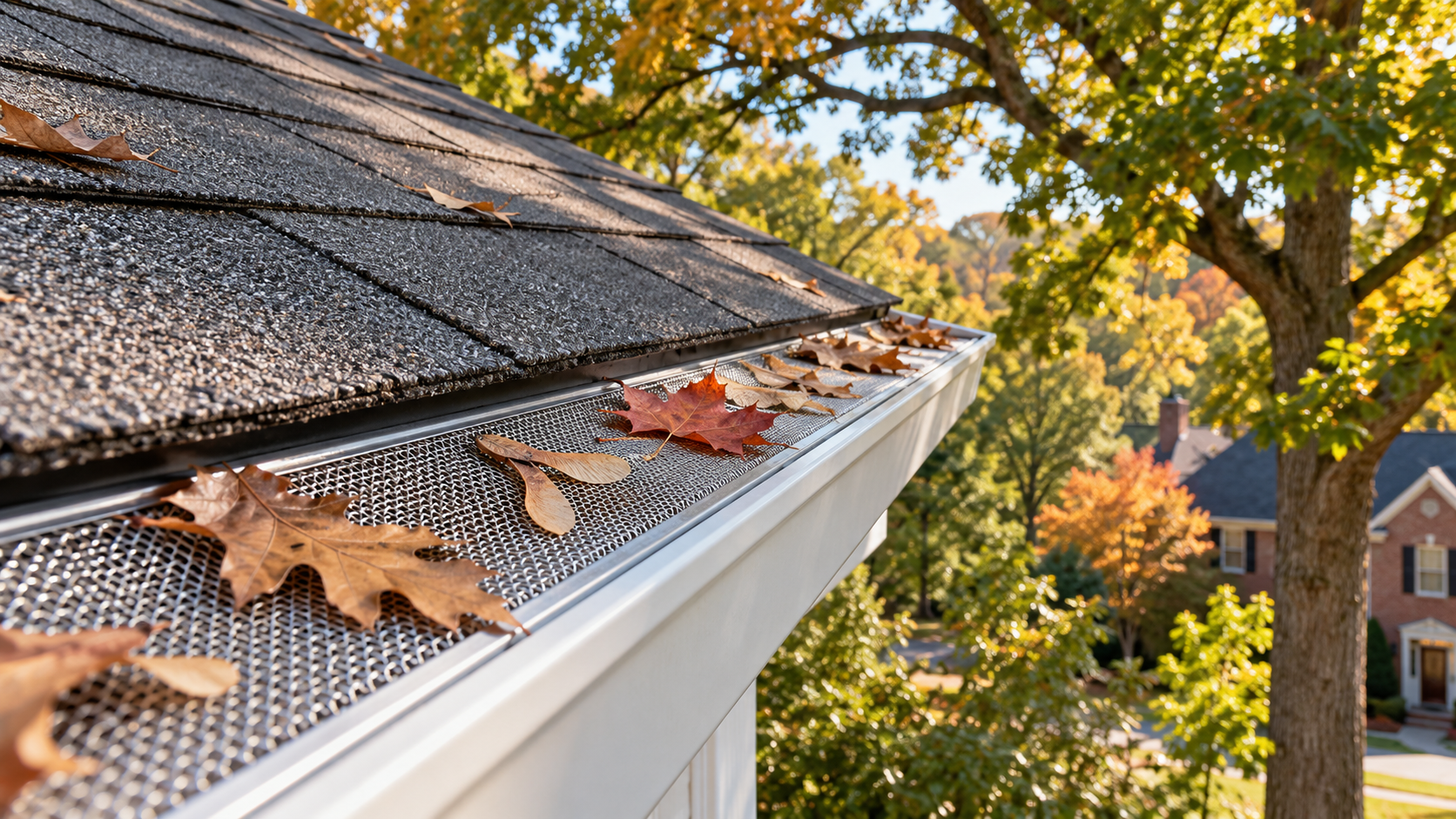
No gutter guard eliminates maintenance. That is the honest starting point, and any company telling you otherwise is selling rather than advising. What a good guard does is reduce cleaning frequency and block the debris most likely to cause a blockage. In St. Louis that debris is specific: oak, maple, and sycamore dominate the canopy, and each defeats guards in a different way. Sycamore drops large leaves and shedding bark. Maples release samaras, the winged seeds that slip through wide openings. Oaks drop catkins in spring and hold their leaves late into November. Here is how the main guard types perform against that mix.
How Do the Main Guard Types Compare?
| Type | Typical Cost (installed, per ft) | Blocks Leaves | Blocks Seeds and Grit | Main Weakness |
|---|---|---|---|---|
| Screen (aluminum or steel mesh) | $3 to $6 | Yes | Partially | Debris mats on top; needs sweeping |
| Micro-mesh (stainless) | $8 to $20+ | Yes | Yes | Fine grit and pollen can blind the mesh |
| Reverse curve / surface tension | $8 to $18 | Yes | Partially | Heavy rain can overshoot; visible from ground |
| Foam insert | $2 to $5 | Yes | No | Traps seeds and grit; degrades; grows debris |
| Brush insert | $2 to $5 | Partially | No | Catches everything in the bristles |
Prices vary widely by product line, gutter length, roof height, and whether existing gutters need repair first. Treat these as planning ranges rather than quotes.
Which Type Handles St. Louis Trees Best?
Micro-mesh performs best against the full debris mix. Stainless micro-mesh blocks maple samaras and oak catkins that pass straight through wider screens, and it stops the shingle granules that accumulate as an asphalt roof ages. The trade-off is cost and the fact that very fine material can blind the mesh surface over time, requiring periodic rinsing.
Screens are a reasonable middle option for homes with moderate tree cover, particularly where the dominant trees are large-leaf species like sycamore. They stop leaves effectively. They do not stop seeds or grit, and debris tends to mat on the surface, so expect to sweep them.
Reverse curve systems work on the principle of water adhesion, carrying water around a curved nose while debris falls past. They handle leaves well. Their weakness is heavy downpours, where water can overshoot the opening entirely, and they are more visible from the ground, which matters on homes where appearance is a consideration.
Foam and brush inserts are the cheapest and the least effective under heavy canopy. Both trap seeds, grit, and pine needles inside the gutter rather than keeping them out. Under oak and maple they often create the blockage they were meant to prevent, and foam degrades with UV exposure.
Does the Roof Matter as Much as the Trees?
Yes, and this gets overlooked. As asphalt shingles age they shed granules continuously, and those granules are fine enough to pass through screens and accumulate in the gutter regardless of what guard is installed. If your roof is in its final years, granule load is part of your debris problem and no guard solves it.
This is why gutter guard installation is often better timed alongside a roof replacement than as a standalone project. New shingles shed far less, the gutters can be evaluated and repaired while crews are already on site, and the guard is installed against a system that will not be disturbed for decades.
What Should I Ask Before Buying?
Ask what the guard does about seeds and granules, not just leaves, since leaves are the easy part. Ask whether your existing gutters and fascia are sound enough to support the system, because guards add weight and installing them over failing gutters wastes the investment. Ask what maintenance the product still requires and how often. Ask whether the warranty covers clogs, and read what voids it. And ask whether installation involves lifting shingles or fastening under the first course, which can affect your roof warranty.
Be skeptical of any pitch built on the phrase never clean your gutters again. Under a St. Louis oak canopy that claim does not survive contact with reality.
Family First Exteriors installs and repairs gutter systems and gutter protection across the St. Louis metro and will tell you honestly whether guards make sense for your specific tree cover.
About Family First Exteriors
Family First Exteriors, LLC provides gutter systems and gutter protection across the greater St. Louis area. Also handles roof replacement, storm damage, siding, soffit and fascia, and windows. Since 2002. 20% discount for veterans, first responders, seniors. Financing available.
15009 Manchester Rd, Ste 261, Ballwin, MO 63011
Phone: (314) 255-8151
Request a Free Estimate
Frequently Asked Questions
Do gutter guards eliminate cleaning?
No. Guards reduce how often cleaning is needed and block larger debris, but fine material such as shingle granules, maple samaras, oak catkins, and pollen still accumulates. Under heavy St. Louis tree canopy, guarded gutters still require periodic inspection and occasional clearing.
Which gutter guard is best for oak and maple trees?
Stainless micro-mesh performs best against the St. Louis debris mix. It blocks maple samaras and oak catkins that pass through wider screens, along with shingle granules. The trade-offs are higher cost and the need to rinse the mesh periodically when fine material blinds the surface.
Are foam gutter inserts any good?
They are the cheapest option and the least effective under heavy tree cover. Foam traps seeds, grit, and needles inside the gutter rather than excluding them, degrades under UV exposure, and can create the blockage it was meant to prevent. Brush inserts have the same core weakness.
How much do gutter guards cost in St. Louis?
Installed costs generally run $2 to $5 per foot for foam and brush inserts, $3 to $6 for screens, $8 to $18 for reverse curve systems, and $8 to $20 or more for stainless micro-mesh. Final pricing depends on gutter length, roof height, product line, and whether existing gutters need repair first.
Can gutter guards damage my roof or void my warranty?
Some installation methods involve lifting shingles or fastening beneath the first course, which can affect a manufacturer roof warranty. Ask any installer how the system attaches before agreeing to the work, and confirm the method is compatible with your shingle warranty terms.
Should I install gutter guards before or after a new roof?
After, or ideally at the same time. Aging shingles shed granules continuously, which accumulate regardless of guard type. Installing guards alongside a roof replacement means less granule load, the chance to repair gutters while crews are on site, and no need to disturb the system later.
Honest Advice on Whether Guards Make Sense for Your Home.
Free estimates on gutter systems and gutter protection across the St. Louis metro.
(314) 255-8151 | Request Your Free Estimate Online
Serving Ballwin, Kirkwood, Webster Groves, Creve Coeur, Chesterfield, Wildwood, and the entire St. Louis metro since 2002.