
August 4, 2026
Architectural Shingles vs. 3-Tab: Is the Upgrade Worth It in St. Louis?
Architectural shingles cost $4.25 to $7.50 per square foot installed in the St. Louis market in 2026, compared to $3.50 to $4.75 for 3-tab shingles. On a typical 2,000 square foot roof, the upgrade adds $2,000 to $4,000 to the project cost. But architectural shingles last 25 to 30 years versus 15 to 20 for 3-tab, carry wind ratings of 110 to 130 MPH versus 60 to 70 MPH, and now account for roughly 75% of all new residential roofing installations nationwide. Over a 30-year period, architectural shingles are actually the cheaper option because you install one roof instead of potentially two. Here is the full comparison.
What Is the Difference Between Architectural and 3-Tab Shingles?
3-tab shingles are a single-layer shingle with three uniform tabs cut along the bottom edge. They create a flat, repetitive appearance on the roof. They are the lightest-weight asphalt shingle available and have been the standard residential roofing product since the 1960s.
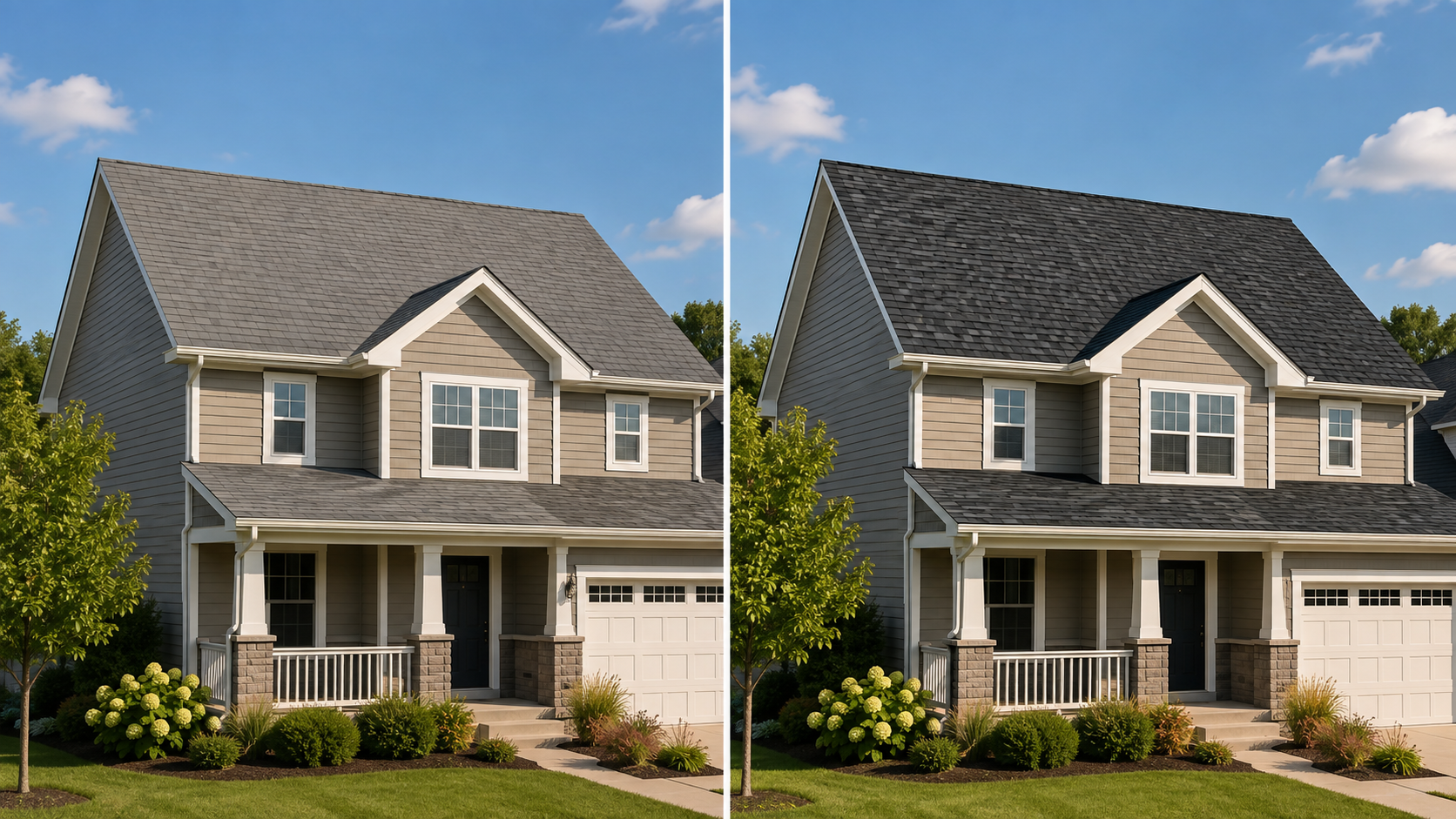
Architectural shingles (also called dimensional or laminated shingles) are made from two or more layers of asphalt bonded together. The layered construction creates a thicker, heavier shingle with a dimensional shadow effect that mimics the look of natural wood shake or slate. They are structurally stronger, more wind-resistant, and significantly more durable than 3-tab.
How Do They Compare Side by Side?
| Feature | 3-Tab Shingles | Architectural Shingles |
|---|---|---|
| Installed cost per sq ft | $3.50 to $4.75 | $4.25 to $7.50 |
| Total cost (2,000 sq ft roof) | $7,000 to $9,500 | $8,500 to $15,000 |
| Rated lifespan | 15 to 20 years | 25 to 30 years |
| Wind rating | 60 to 70 MPH | 110 to 130 MPH |
| Weight per square (100 sq ft) | 200 to 240 lbs | 300 to 400 lbs |
| Impact resistance options | Not available in Class 4 | Class 4 UL 2218 available |
| Appearance | Flat, uniform tabs | Dimensional, shadow lines |
| Warranty (premium tier) | 25 years (limited) | 50 years non-prorated |
| Insurance discount eligible | No | Yes (Class 4 versions: 10-35% in MO) |
| Market share (new installs) | ~25% | ~75% |
Is the Upgrade Worth It Financially?
This is where the math tells the real story. Consider two scenarios for a St. Louis homeowner with a 2,000 square foot roof over a 30-year period:
Scenario A: Two 3-tab roofs over 30 years. First install at $8,000. Second install 15 to 18 years later at $9,500 to $11,000 (adjusted for inflation). Total 30-year cost: $17,500 to $19,000. Two tear-offs. Two disruptions. Two permit fees. Two dumpster loads in a landfill.
Scenario B: One architectural roof over 30 years. Single install at $12,000. No second install needed. Total 30-year cost: $12,000. One tear-off. One disruption. Better wind and hail protection throughout.
The architectural upgrade pays for itself within the first 15 years simply by eliminating the second roof replacement. Add in the stronger wind warranty (110 to 130 MPH vs. 60 to 70 MPH for 3-tab), the availability of Class 4 impact-rated options that earn 10% to 35% Missouri insurance discounts, and the higher curb appeal that supports resale value, and the financial case is clear.
When Does 3-Tab Still Make Sense?
3-tab shingles are not a bad product. There are legitimate situations where they remain the right choice:
Rental properties or investment homes where minimizing upfront cost matters more than long-term durability. If you plan to sell the property within 5 to 10 years, 3-tab gets the job done at a lower price point.
Detached garages, sheds, or outbuildings where appearance and warranty length are less important than basic weather protection.
Budget-constrained situations where the homeowner genuinely cannot afford the $2,000 to $4,000 difference. A new 3-tab roof is far better than a failing old roof of any type. That said, financing options can often bridge the gap and make architectural shingles affordable.
Matching existing 3-tab on a partial repair. If you are replacing one section of a 3-tab roof and cannot afford to replace the entire roof, matching the existing material makes sense.
How Does Shingle Choice Affect Insurance in Missouri?
Missouri insurance carriers increasingly factor roof type into premium calculations. Architectural shingles with Class 4 impact resistance (such as GAF Timberline ArmorShield II, Owens Corning Duration FLEX, or CertainTeed NorthGate) qualify for premium discounts of 10% to 35% depending on the carrier. 3-tab shingles do not come in Class 4 options and do not qualify for these discounts.
Additionally, the lower wind rating of 3-tab shingles (60 to 70 MPH) means more frequent wind damage claims after the severe thunderstorms St. Louis experiences regularly. Architectural shingles at 110 to 130 MPH withstand the vast majority of straight-line wind events without damage, reducing claim frequency and keeping your loss history clean.
Family First Exteriors installs both architectural and 3-tab shingles and can help you compare the options for your specific situation. Request a free roof replacement estimate to see the price difference on your home.
About Family First Exteriors
Family First Exteriors, LLC provides roof replacement with architectural and 3-tab shingle options across the greater St. Louis area. Also handles storm damage, siding, gutters, and windows. Since 2002. 20% discount for veterans, first responders, seniors. Financing available.
15009 Manchester Rd, Ste 261, Ballwin, MO 63011
Phone: (314) 255-8151
Request a Free Estimate
Frequently Asked Questions
Are architectural shingles worth the extra cost?
Yes for most homeowners. Architectural shingles cost $2,000 to $4,000 more upfront but last 25 to 30 years versus 15 to 20 for 3-tab. Over 30 years, one architectural roof costs less than two 3-tab roofs. They also carry stronger wind ratings, qualify for Missouri insurance discounts in Class 4 versions, and add more curb appeal and resale value.
How much longer do architectural shingles last than 3-tab?
Architectural shingles are rated for 25 to 30 years. 3-tab shingles are rated for 15 to 20 years. In the St. Louis climate with hot summers, freeze-thaw cycling, and frequent severe storms, the heavier construction and stronger adhesion of architectural shingles provide noticeably better long-term durability.
Can I put architectural shingles over 3-tab?
Technically possible but not recommended. Layering adds weight to the roof structure, hides underlying deck damage, voids most manufacturer warranties, and is limited to a maximum of two layers by St. Louis County building code. A full tear-off and fresh installation gives you the best result and full warranty coverage.
Do architectural shingles increase home value?
Yes. A new architectural shingle roof is consistently rated one of the top home improvements for return on investment. The dimensional appearance, longer warranty, and stronger wind and hail performance are selling points that appraisers and buyers recognize. 3-tab roofs are increasingly seen as a dated, economy-grade product.
What wind speed can architectural shingles withstand?
Standard architectural shingles are rated for 110 to 130 MPH winds. GAF offers an unlimited wind speed warranty through their WindProven system when installed by a certified contractor. 3-tab shingles are rated for only 60 to 70 MPH, which is below the threshold of many St. Louis severe thunderstorms.
When does 3-tab still make sense?
3-tab is a reasonable choice for rental properties where minimizing upfront cost matters most, detached garages and outbuildings, budget-constrained situations where the $2,000 to $4,000 difference is prohibitive, or partial repairs where you need to match existing 3-tab material on the same roof.
Not Sure Which Shingle Is Right for Your Home?
Family First Exteriors provides free side-by-side estimates for architectural and 3-tab options on your specific roof.
(314) 255-8151 | Request Your Free Estimate Online
Serving Ballwin, Kirkwood, Webster Groves, Creve Coeur, Chesterfield, Wildwood, Des Peres, Ellisville, Maplewood, and the entire St. Louis metro. 20% discount for veterans, first responders, and seniors.