
October 21, 2026
Your Roof Failed Over a Holiday Weekend: What to Do When Contractors Are Closed
Holiday weekends produce a disproportionate share of discovered roof leaks, and the reason is simple: you are home, the house is full, and someone finally looks up at the ceiling. Thanksgiving falls on November 26 this year, and it lands right after the average first hard freeze in St. Louis. If water is coming in and your contractor’s office is dark, here is what to do in the first hour, what to document, and what genuinely cannot wait until Monday.
What Do I Do in the First Hour?
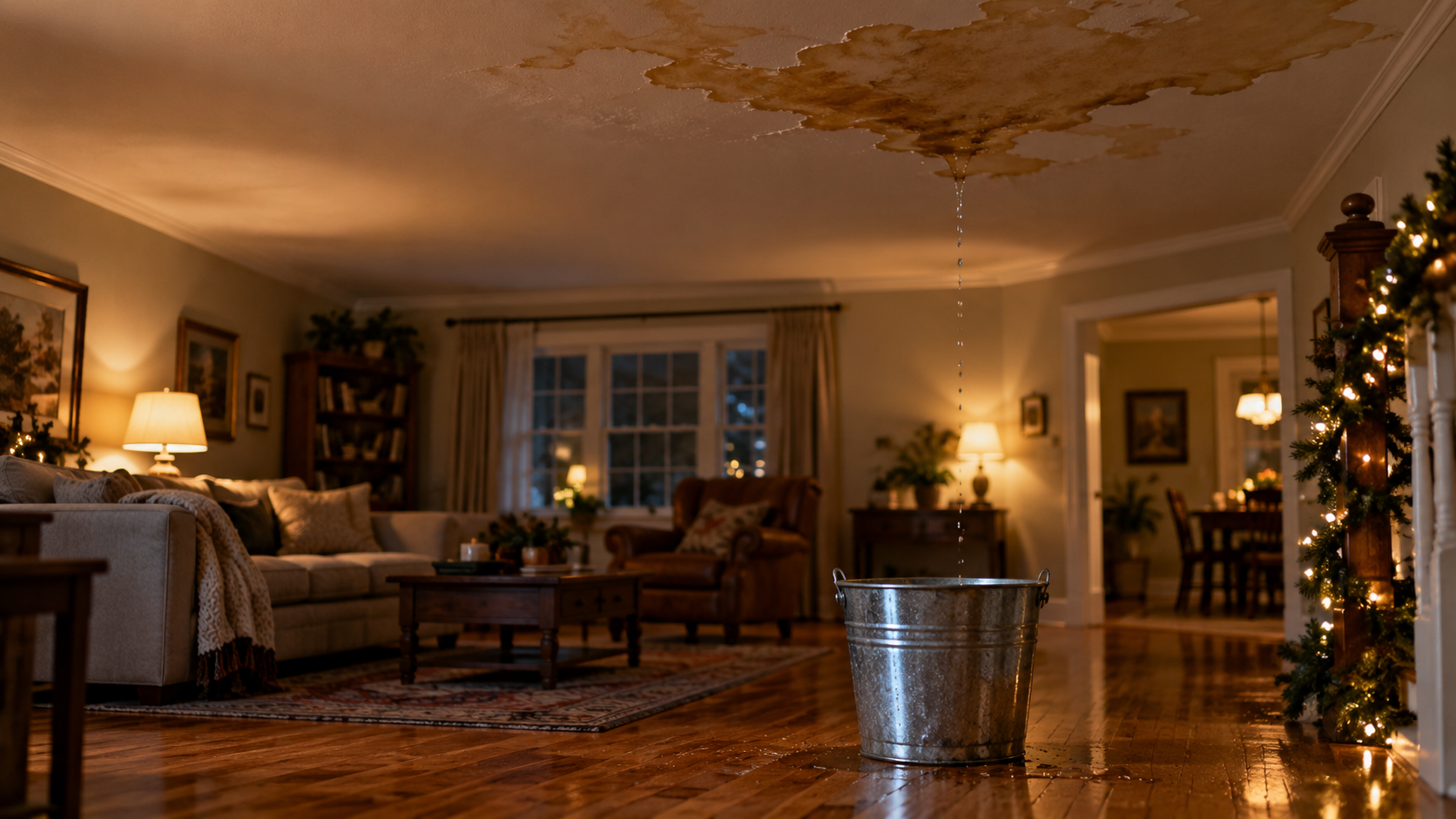
Protect the interior before anything else. Put a bucket or bin under the drip. Move furniture, rugs, and electronics out of the area. If water is spreading across a ceiling and the drywall is bulging, that bulge is holding a pocket of water. Puncturing it deliberately with a small hole at the lowest point and catching the water in a bucket is usually better than letting it collapse on its own, because a collapse soaks a far larger area.
Kill power to the affected area. If water is anywhere near a light fixture, ceiling fan, or outlet, switch off that circuit at the breaker. Water and electricity in a ceiling cavity is the one genuinely dangerous part of a roof leak.
Do not get on the roof. Not in the dark, not in cold or wet conditions, and not on a holiday when nobody is around if something goes wrong. Nothing you can accomplish up there outweighs the risk, and a fall turns a repair bill into an emergency room visit.
Photograph everything before you clean up. This is the step people skip and regret. Take wide shots showing the room and the ceiling, close shots of the damage, and photos of any damaged belongings. Your phone timestamps them automatically, which matters for a claim.
Who Actually Answers on a Holiday?
More than you would expect. Reputable roofing contractors in storm-prone markets maintain genuine 24/7 emergency lines, because hail and wind do not observe business hours. Family First Exteriors answers at (314) 255-8151 around the clock.
What an emergency call typically produces is temporary tarping, generally $300 to $800 depending on the area covered, to stop water entry until a permanent repair can be scheduled. That is the realistic goal on a holiday weekend. A full repair or replacement needs daylight, dry conditions, material deliveries, and sometimes a permit, none of which exist on Thanksgiving Day.
Your insurance carrier’s claims line is also typically staffed 24/7, separate from your local agent’s office. Most Missouri policies require you to take reasonable steps to prevent further damage, which is called your duty to mitigate. Emergency tarping satisfies that obligation, and the cost is usually reimbursable, so keep the receipt.
What Can Wait Until Monday?
| Situation | Call Now | Can Wait |
|---|---|---|
| Active dripping into living space | Yes | |
| Water near electrical fixtures | Yes | |
| Bulging or sagging ceiling | Yes | |
| Visible hole or missing roof section | Yes | |
| Water entering during a storm in progress | Yes | |
| Old dry stain you just noticed | Yes | |
| Small damp spot, not growing | Yes | |
| Ice dam with no interior water yet | Yes, monitor closely | |
| Missing shingles, no leak | Yes |
A dry stain you have simply never noticed before is not an emergency. It may be months or years old. Photograph it, note the date, and call during business hours.
How Do I Document This for Insurance?
Build the record while it is happening, because reconstructing it later is much weaker. Photograph the interior damage from several angles before cleanup. Note the date and time water was first observed. Save receipts for buckets, tarps, fans, and any emergency service. Keep damaged belongings rather than discarding them until an adjuster has seen them or you have been told otherwise. Write down the weather conditions, since a claim tied to a specific storm event is stronger than one with no cause attached.
Call your carrier’s claims line even on the holiday to open the claim and get a claim number. Opening a claim is not the same as committing to pursue it, and the timestamp helps.
Why Do Leaks Appear Over Holidays?
Part of it is simply occupancy and attention. Part of it is seasonal. Late November in St. Louis brings the first sustained freeze-thaw cycling of the year, which is exactly the condition that widens existing flashing gaps and cracks aging pipe boot collars. A small defect that held through October rain will often fail in the first hard freeze.
Interior heating plays a role too. Once the furnace runs steadily, warm attic air meets a cold roof deck and produces condensation that drips onto insulation and ceilings. That is not technically a roof leak at all, and it is why some holiday water problems persist even when the roof itself is sound.
If you want to avoid the call entirely, the time to find these problems is before the freeze, not during it. A roof inspection in October or early November catches the flashing and ventilation issues that produce December emergencies.
About Family First Exteriors
Family First Exteriors, LLC answers emergency calls 24/7 and provides storm damage response and emergency tarping across the greater St. Louis area. Also handles roof replacement, siding, gutters, and windows. Since 2002. 20% discount for veterans, first responders, seniors. Financing available.
15009 Manchester Rd, Ste 261, Ballwin, MO 63011
Phone: (314) 255-8151 (24/7)
Request a Free Estimate
Frequently Asked Questions
What do I do if my roof leaks on a holiday?
Contain the water with buckets and move belongings clear. Switch off power to the circuit if water is near fixtures. Photograph everything before cleanup. Call a contractor with a genuine 24/7 line for emergency tarping, and open a claim with your insurer. Do not climb onto the roof.
Should I puncture a bulging ceiling?
Usually yes. A bulge means drywall is holding a pocket of water. A small controlled hole at the lowest point, with a bucket underneath, releases it in one place. Letting it collapse on its own soaks a much larger area and causes more damage. Turn off nearby electrical circuits first.
How much does emergency roof tarping cost?
Typically $300 to $800 in the St. Louis area depending on the size of the area covered. This cost is usually reimbursable through your insurance claim as a mitigation expense, since most policies require you to take reasonable steps to prevent further damage. Keep the receipt.
Can I file an insurance claim on a holiday?
Yes. Insurance carrier claims lines are typically staffed 24/7, separate from your local agent’s office. Opening a claim on the day of the loss creates a timestamp and gets you a claim number. Opening a claim does not commit you to pursuing it.
Which roof problems can wait until Monday?
An old dry stain you simply had not noticed, a small damp spot that is not growing, missing shingles with no interior water, and an ice dam with no water entering yet. Active dripping, bulging ceilings, water near electrical, and visible holes all warrant a call immediately.
Why do roof leaks show up around Thanksgiving?
Late November brings the first sustained freeze-thaw cycling in St. Louis, which widens existing flashing gaps and cracks aging pipe boot collars. Steady furnace use also creates attic condensation on the cold roof deck. Add a full house of people looking at ceilings and problems get discovered.
Roof Emergency? We Answer 24/7.
Emergency tarping and storm response across the St. Louis metro, holidays included.
(314) 255-8151 | Request Help Online
Serving Ballwin, Kirkwood, Webster Groves, Creve Coeur, Chesterfield, Wildwood, and the entire St. Louis metro since 2002.