
October 12, 2026
Full-Frame vs. Insert Replacement Windows: What St. Louis Homeowners Are Actually Paying For
Two window quotes can describe the same number of openings and still cover very different jobs. One may keep your existing frames. The other may remove them, expose the rough openings, and include new trim and related repairs.
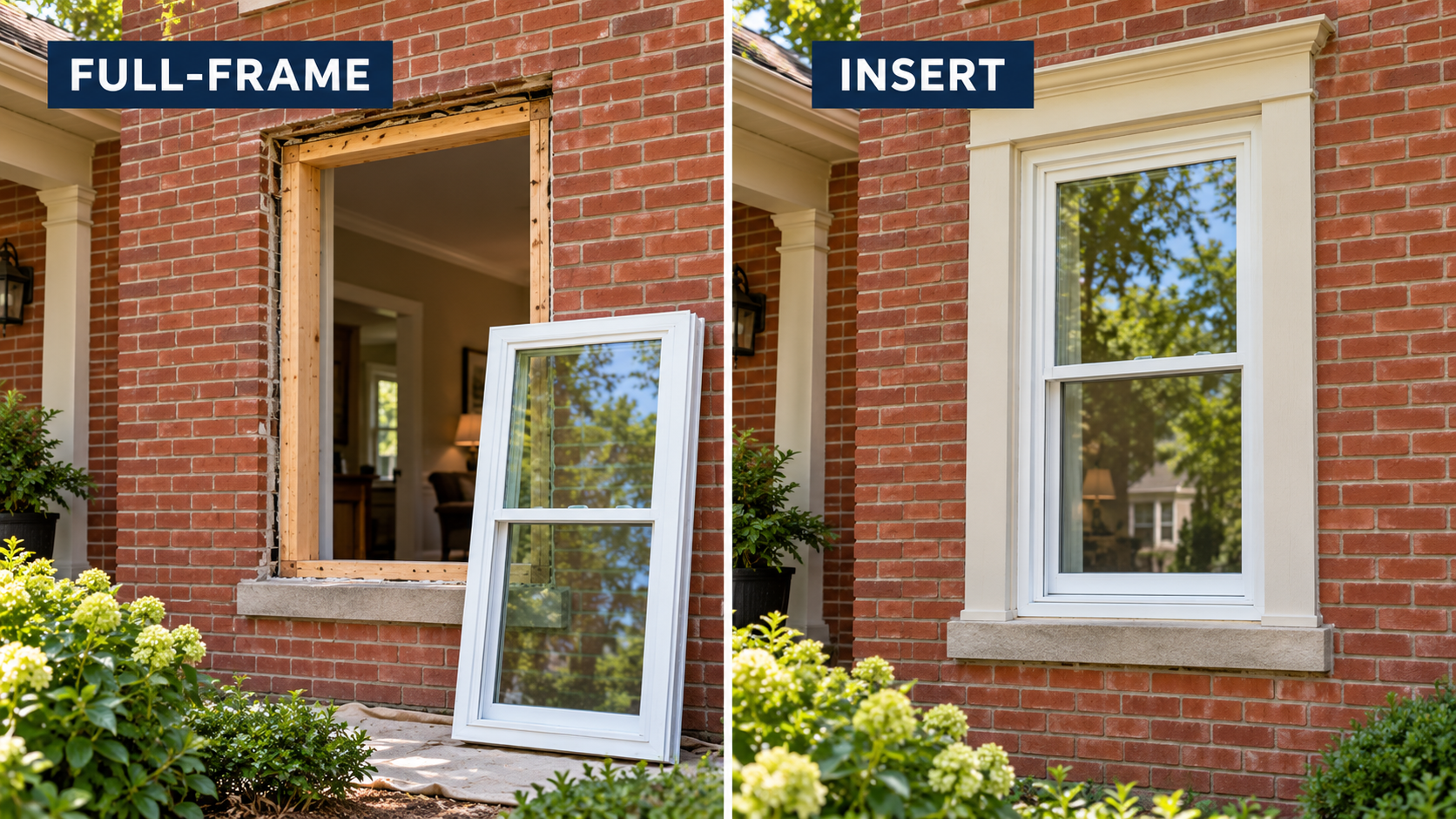
An insert replacement fits a new window into a suitable existing frame. A full-frame replacement removes the old window frame as well. The right choice starts with what can safely remain, then considers appearance, disruption, and the written scope.
Full-frame vs. insert windows at a glance
| Question | Insert replacement | Full-frame replacement |
|---|---|---|
| What happens to the existing frame? | It stays and receives the new unit. | It is removed to expose the rough opening. |
| What condition is suitable? | The retained frame must be sound and square. | Worth evaluating when the old frame is deteriorated or out of square. |
| What happens to trim? | Typically preserves surrounding interior casing and exterior trim. | Removal and finish work are part of the scope to clarify. |
| What should the quote explain? | Why the frame can remain and how the new unit will be fitted and sealed. | Removal, opening preparation, water management, repairs, and finish restoration. |
These distinctions follow Andersen’s insert replacement guidance and its full-frame replacement guidance. The selected product’s installation instructions still control the details.
When keeping the existing frame makes sense
Andersen identifies an existing frame without rot, a square opening, and a desire to preserve trim as conditions suited to its insert products. That makes frame inspection a decision point, not a formality.
For your St. Louis home, ask the estimator to show you which parts will remain. Have them explain what they checked at the sill and lower corners, and whether any observed staining needs further investigation before ordering.
If you want to preserve substantial wood casing, say so at the first visit. Ask what “preserve” includes: will stops be replaced, will nail holes need filling, and who handles any touch-up work? Photograph the existing finish so expectations are clear.
When to evaluate full-frame replacement
Andersen lists rot, an out-of-square window, and changes to size or shape as reasons to consider full-frame replacement. Its removal process exposes the rough opening, giving the installer access that an insert installation does not automatically provide.
Ask for a diagnosis before choosing a method solely because a window leaks. Where is water entering? What work will correct that route? A proposal should connect the observed problem to the proposed repair.
For a brick exterior, request a description of the perimeter finish and any masonry work included. For a sided wall, ask what surrounding materials will be disturbed and how they will be restored. Do not assume “full-frame” means every adjoining repair is included in the price.
What are you actually paying for?
Renewal by Andersen’s comparison describes insert work as generally less disruptive and less expensive when the existing frame is suitable. Full-frame work involves a more extensive removal and installation scope. That explains why installation method matters when comparing prices; it does not establish a price for your house.
Request separate answers for these parts of each proposal:
- The window: Manufacturer, product line, operating style, glass package, finish, and dimensions.
- Removal: Exactly which existing parts will come out, and whether disposal is included.
- Opening preparation: What is included before the new window goes in.
- Installation: The product-specific fastening, sealing, and water-management approach.
- Finishing: Interior casing, exterior trim or wrapping, painting, staining, and cleanup.
- Unknown repairs: How concealed damage will be documented, priced, and approved.
Then compare equivalent scopes. If one contractor recommends inserts and another recommends full-frame work, ask each to explain the condition that drives the recommendation. A lower number is useful only when you understand what it includes.
Keep energy performance separate from installation scope
Ask about both the window product and the surrounding opening. ENERGY STAR advises insulating the space between the frame and rough opening during installation. Its guidance on sealing behind trim also explains that leakage around that area can matter even when the window itself is airtight.
Useful questions are: Where is the draft coming from? How will this scope address it? Which existing gaps will be accessible? Ask for the proposed product’s performance information rather than relying on a general promise of lower bills.
Five questions to settle before signing
- Which method applies to each opening? Request a room-by-room schedule if the recommendations vary.
- What will the finished window look like? Ask for visible glass dimensions, frame profiles, and trim details for the actual unit quoted.
- What happens if removal reveals damage? Agree on photographs and written change-order approval.
- Who restores the finishes? Specify whether painting or staining is included or left to you.
- What will the final walkthrough cover? Include operation, locks, screens, finish condition, cleanup, and delivery of warranty documents.
Frequently asked questions
Is an insert window the same as replacing only the glass?
No. An insert is a window unit fitted into the retained frame. Glass-only work is a different repair scope. If that is the question you are starting with, see our guide to new windows versus glass replacement, then ask for an assessment of your particular window.
Should every window in the house use the same method?
Ask for a recommendation for each opening rather than assuming one method fits the entire house. Record any differences in the proposal so the crew and homeowner have the same expectations.
Does full-frame replacement automatically include changing the opening size?
No. Frame removal and changing the wall opening are separate scope questions. If you want a larger or differently shaped window, request an explicit proposal for that change before ordering.
Can I keep my existing interior trim?
Insert replacement is designed to preserve surrounding casing where conditions permit. For either method, ask the contractor to identify what stays, what comes off, and what finish repairs are included.
Choose the scope your home needs
Start with frame condition and a clear explanation of the work. Then compare products and prices using the same checklist. You should be able to point to every retained component and understand why it can stay.
Family First Exteriors offers replacement window services for St. Louis homeowners. Contact the team to discuss your windows and request a proposal that explains the recommended installation scope.