
October 5, 2026
What’s Actually Under Your Roof? Decking by St. Louis Home Era
The most common source of an unexpected bill during a roof replacement is decking, the structural sheathing your shingles are nailed to. Nobody can see it until the old roof comes off. What is under there depends heavily on when your home was built, and St. Louis has housing stock spanning more than a century. Knowing what to expect for your home’s era lets you budget realistically and tells you whether a contractor’s estimate is being honest with you before the tear-off starts.
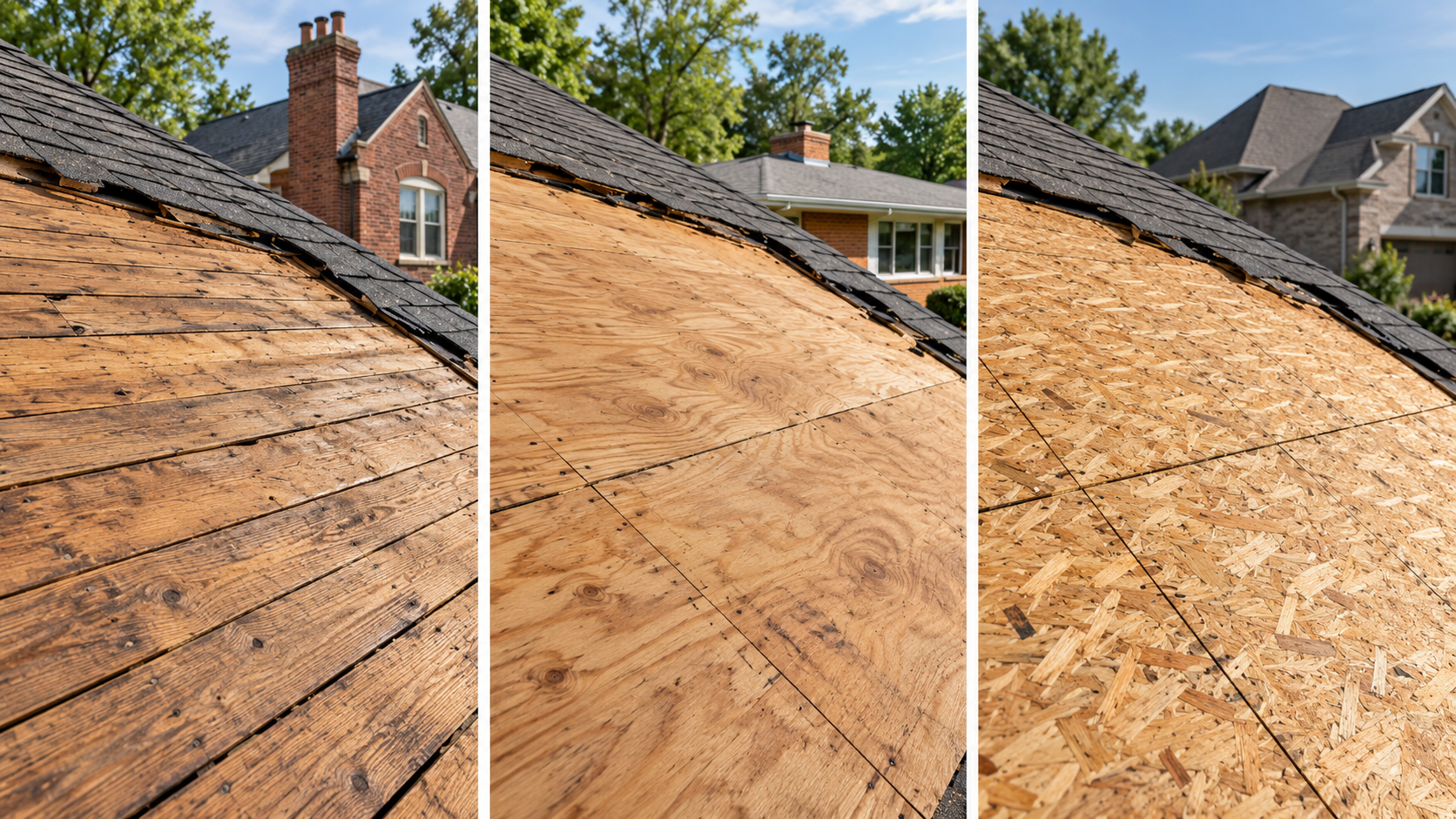
What Decking Is Under Homes of Each Era?
| Era | Typical Decking | What to Expect at Tear-Off |
|---|---|---|
| Pre-1950 | Individual wood planks, often 1×6 or 1×8 with gaps | Board replacement, possible full re-deck for nailing surface |
| 1950s-1970s | Plywood sheets, sometimes over original plank | Generally sound; localized rot at penetrations and valleys |
| 1980s-present | OSB (oriented strand board) | Sound unless wet; OSB degrades faster than plywood once saturated |
Plank decking is common in St. Louis city neighborhoods and older county municipalities. Individual boards were laid with small gaps for expansion. The wood is often excellent old-growth material and can be in fine condition after a century. The complication is the gaps. Modern shingles need consistent nailing surface, and where gaps are too wide or boards have cupped, an overlay sheet of plywood may be required across the whole roof rather than a few board swaps.
Plywood became standard mid-century and holds up well. Failures are usually localized, concentrated around plumbing penetrations, chimneys, valleys, and eaves where water has been working at a specific point for years.
OSB is the current standard and performs fine dry. Its weakness is water. Once saturated, OSB swells at the edges and loses structural integrity faster than plywood does, so a long-undetected leak on an OSB deck often means more replacement than the same leak on plywood.
How Much Does Decking Replacement Cost?
Decking is typically priced per sheet or per board as a separate line item, because no contractor can quote it accurately in advance. A reputable estimate will state the per-unit price up front so you know the rate before work begins.
Ask three questions of any estimate: what is the per-sheet or per-board price, how many units are included in the base quote, and will you be shown the damaged material before it is removed. The last one matters. Decking replacement is the easiest place for a dishonest contractor to inflate a bill, because the evidence goes in the dumpster.
Why Do Some Estimates Not Mention Decking At All?
That is a warning sign rather than a convenience. A contractor who does not address decking is either planning to surprise you mid-job with an unpriced change order, or planning to shingle over compromised material and leave. Both outcomes are worse than a slightly higher quote that names the rate honestly.
This is also one of the practical arguments against a layover, where new shingles are installed over the existing layer without a tear-off. A layover leaves the decking unseen and unaddressed, which is fine until it is not. St. Louis County code limits roofs to two layers, and the second layer hides exactly the information you need.
What Can I Learn Before the Tear-Off?
More than you might expect, from inside the attic with a flashlight. Look at the underside of the deck. Plank decking is visibly individual boards with gaps. Plywood and OSB appear as sheets, and OSB has a distinctive flaked appearance. Look for dark staining, which indicates past or present water intrusion. Look for daylight, which means active openings. Press gently on suspect areas for softness, and check around every plumbing vent and chimney, since those are where problems concentrate.
Newer decking replaced during a previous roof job is usually obvious, appearing lighter in color than the surrounding original material.
Family First Exteriors states decking pricing as a line item on every estimate and shows homeowners the damaged material before it is removed. Request an estimate.
About Family First Exteriors
Family First Exteriors, LLC provides roof replacement with transparent, line-item estimates across the greater St. Louis area. Also handles storm damage, siding, soffit and fascia, gutters, and windows. Since 2002. 20% discount for veterans, first responders, seniors. Financing available.
15009 Manchester Rd, Ste 261, Ballwin, MO 63011
Phone: (314) 255-8151
Request a Free Estimate
Frequently Asked Questions
What is roof decking?
Decking, also called sheathing, is the structural layer your shingles are nailed to. It sits on the rafters beneath the underlayment. Depending on your home’s era it is either individual wood planks, plywood sheets, or oriented strand board. It cannot be inspected until the old roof is removed.
What decking is under an older St. Louis home?
Homes built before roughly 1950 typically have individual wood plank decking laid with small gaps. The wood is often high quality old-growth material, but the gaps can create a nailing problem for modern shingles, sometimes requiring an overlay sheet across the roof rather than spot board replacement.
Is OSB decking worse than plywood?
Not when dry. OSB performs well as a decking material under normal conditions. Its disadvantage is water: once saturated, OSB swells at the edges and loses structural integrity faster than plywood. A long-undetected leak therefore tends to require more replacement on an OSB deck.
Why is decking priced separately on a roofing estimate?
Because nobody can see it until tear-off. A reputable contractor lists a per-sheet or per-board rate in the estimate so you know the price before work starts, then charges only for what is actually replaced. An estimate that does not mention decking at all is a warning sign.
How do I know the contractor isn’t inflating decking charges?
Ask to be shown the damaged material before it is removed, and ask for photos of each replaced area. Agree on the per-unit rate in writing beforehand. Decking is the easiest line item to inflate because the evidence goes into the dumpster, so documentation is the protection.
Can I check my own decking before getting quotes?
Partially. From inside the attic with a flashlight you can identify whether it is plank, plywood, or OSB, spot dark water staining, look for daylight through the deck, and check for softness around plumbing vents and chimneys. That tells you a lot, though the top surface stays hidden until tear-off.
No Surprise Decking Bills.
Line-item estimates with decking rates stated up front, and photos of anything we replace.
(314) 255-8151 | Request Your Free Estimate Online
Serving Ballwin, Kirkwood, Webster Groves, Creve Coeur, Chesterfield, Wildwood, and the entire St. Louis metro since 2002.