
June 10, 2026
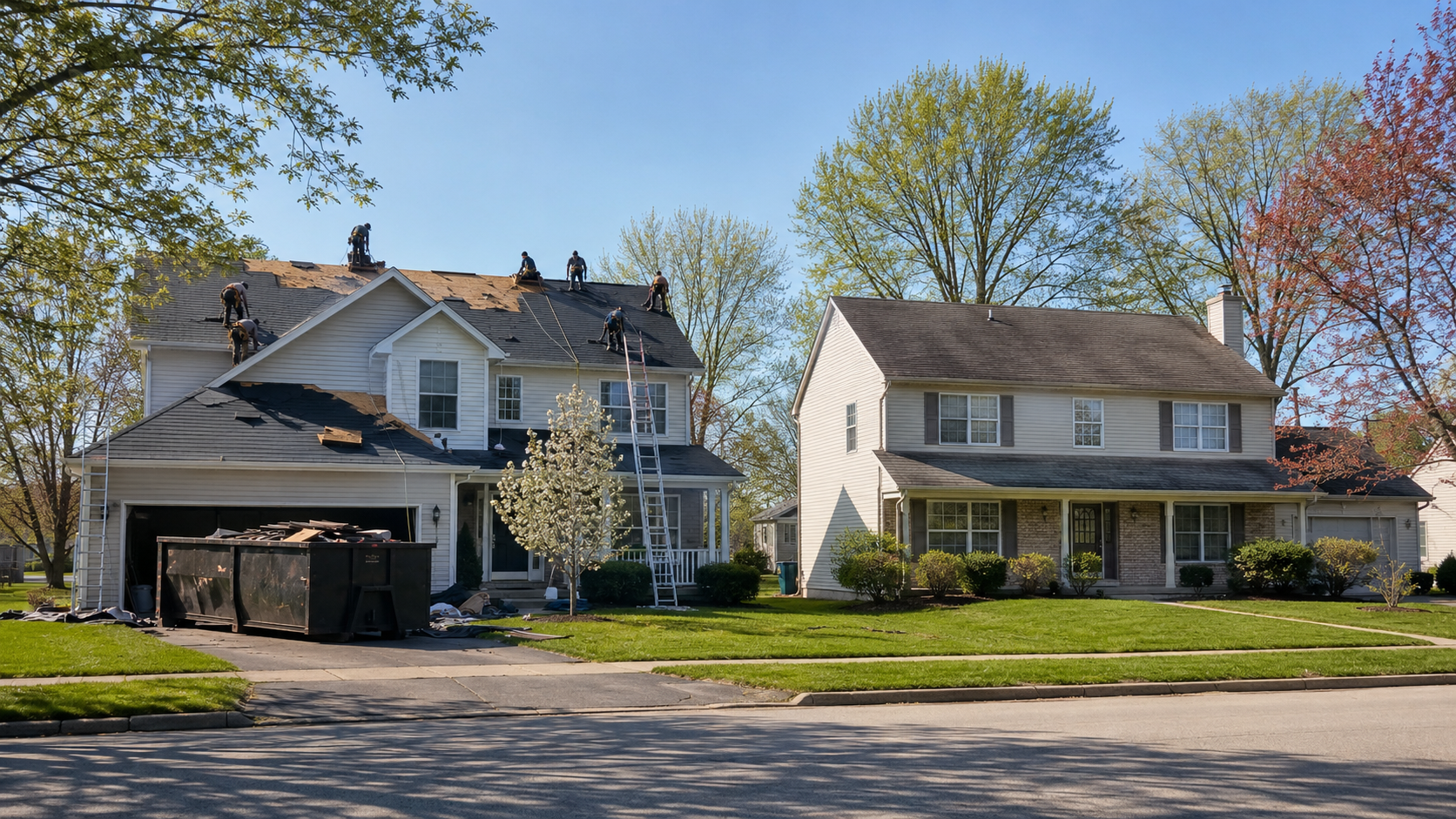
Your Neighbor Just Got a New Roof After a Storm. Should You Get Yours Inspected?
If a roofing crew is working on your neighbor’s house after a recent storm in St. Louis, your roof was almost certainly hit by the same hail. Hail damage corridors are typically 0.5 to 5 miles wide, according to Storm Prediction Center severe weather report patterns. Within that corridor, every roof on every block absorbs the same impact. The difference between your neighbor getting a new roof and you getting a surprise leak next winter is often just one phone call: scheduling an inspection before the insurance filing window closes. Most Missouri homeowners policies require storm damage claims to be reported within 60 days to 12 months of the storm date.
Why Does Hail Damage Hit Entire Neighborhoods at Once?
Hail does not skip houses. When a storm produces hailstones large enough to damage roofing materials (generally 1 inch or larger), every structure within the hail swath receives some level of impact. The swath is the ground-level footprint of the hailstorm, and it moves with the storm cell as it tracks across the metro area.
In St. Louis, severe thunderstorms typically move from southwest to northeast along the I-44 and I-64/Highway 40 corridors. A single storm cell can deposit damaging hail across a path that stretches 10 to 30 miles long and 1 to 5 miles wide. That means a hail event in Ballwin can also affect Ellisville, Manchester, Des Peres, and parts of Creve Coeur in the same pass.
Insurance adjusters understand this. When they process claims, they overlay early claim density data, roofing contractor activity zones, and verified weather reports to map exactly where hail fell. If your neighbor’s claim was approved, your home is almost certainly inside the same documented hail swath. That actually strengthens your own claim, because the storm event has already been validated in your area.
Can My Roof Have Hail Damage Even If It Looks Fine from the Ground?
Yes. This is the most common reason homeowners miss legitimate claims. Hail damage to asphalt shingles is often invisible from ground level. The damage shows up as granule displacement (exposing the dark asphalt mat underneath), bruising (soft spots where the mat is fractured beneath the granule surface), and cracked or loosened seal strips that allow wind uplift. None of these are visible from 30 feet below.
Two homes on the same St. Louis block can also show different levels of damage from the same storm, depending on roof age, shingle type, roof pitch, and orientation relative to the storm’s direction. An older roof with brittle 20-year-old shingles sustains more damage from the same hailstone than a newer roof with flexible architectural shingles. A south-facing slope hit by north-driving hail takes more direct impacts than a sheltered north-facing slope.
The only way to know whether your roof has hail damage is to have a qualified roofing contractor physically get on the roof and inspect it. Ground-level visual checks are not sufficient for hail damage assessment.
How Long Do I Have to File a Claim in Missouri?
This is where timing gets critical. Missouri does not set a single statewide deadline for storm damage insurance claims. Instead, the deadline is controlled by your individual insurance policy. Here is what the data shows across Missouri carriers:
| Policy Requirement | Typical Window | Notes |
|---|---|---|
| Prompt notice of loss | 48 hours to 30 days | Some carriers expect reporting within days of the storm |
| Formal claim filing | 60 days to 12 months | Most common window. Check your policy’s “Duties After Loss” section |
| Maximum statutory period | Up to 2 years | Missouri law allows up to 2 years, but your policy may be shorter |
| Lawsuit for bad faith denial | 5 years | Missouri statute of limitations on insurance contract claims |
The critical detail: the clock starts on the date of the storm, not on the date you discover the damage. A homeowner who notices no interior damage after a May 2026 storm but develops a ceiling stain in January 2027 may be entirely outside the claim window for the storm that caused the underlying shingle damage.
This is why seeing your neighbor get a new roof is an important signal. It means a documented storm event occurred in your area. If you have not had your roof inspected, the filing clock is already ticking. Family First Exteriors has published a detailed guide on Missouri storm damage claim deadlines that covers this topic in depth.
What Should I Do When I See Crews Working on My Neighbor’s Roof?
Here is a practical, step-by-step approach:
Step 1: Note the date. Write down today’s date and the approximate date of the most recent storm that could have caused the damage. If you are unsure, check local weather history or ask your neighbor which storm triggered their claim. This date anchors your own filing timeline.
Step 2: Schedule a professional roof inspection. Do not wait for a leak. Do not wait for a door-knock from a storm chaser. Contact a local roofing contractor you trust and schedule an inspection. Family First Exteriors provides free storm damage inspections with photo documentation throughout the St. Louis metro area.
Step 3: Do not sign anything with door-knockers. After major hail events, out-of-state contractors flood into affected St. Louis neighborhoods, knocking on doors and pressuring homeowners to sign contingency agreements on the spot. These storm chasers track weather patterns and deploy sales teams within hours of a hail event. You have time. There is no requirement to sign anything immediately. Use a local contractor with a permanent St. Louis address and verifiable references.
Step 4: Get the inspection report before calling your insurance company. A detailed damage report from a qualified local contractor gives you a complete picture of what was damaged before you initiate the claim. This documentation strengthens your position and ensures nothing is missed during the adjuster’s visit.
Step 5: File the claim if damage is confirmed. Call your insurance company, report the storm date and the damage, and request an adjuster visit. Ask for the claim number and the adjuster’s name and contact information. A reputable roofing contractor can meet the adjuster at your home to ensure all damage is properly identified and documented in the claim scope.
What If My Neighbor’s Roof Was Replaced Months Ago and I Am Just Now Noticing?
This happens frequently in St. Louis. A storm hits in April, one neighbor files a claim immediately and gets a new roof by June. You were busy, the roof was not leaking, and you did not think about it. Now it is October and you are wondering if it is too late.
It may not be too late, but you need to act immediately. Check your policy’s claim filing deadline. If the storm occurred within the past 12 months, most Missouri policies still allow you to file. If you are approaching or past the 12-month mark, call your insurance agent directly and ask whether you are still within the reporting window.
Even if the formal filing window has passed, Missouri’s statute of limitations on insurance contract claims is five years. If you believe your claim was wrongfully denied or that your carrier failed to act in good faith, you may have legal recourse. Consult with your insurance agent or an attorney who specializes in insurance claims.
The best time to act was right after the storm. The second-best time is today.
Does Filing a Claim Raise My Insurance Premiums?
This is the question that stops many St. Louis homeowners from filing legitimate claims. Here is the reality:
Filing a single weather-related claim generally does not cause a premium increase. Catastrophic weather events (hail, wind, tornado) are classified differently from at-fault claims (burst pipes from neglected maintenance, for example). Insurance carriers expect weather claims in hail-prone markets like St. Louis. It is literally what the policy is for.
However, multiple claims within a short period (2 or more claims within 3 to 5 years) can affect your premium or renewability. This is one reason why upgrading to Class 4 impact-resistant shingles during a replacement makes financial sense: reducing future claim frequency protects your premium long-term.
Not filing a legitimate claim is almost always the worse financial decision. You pay premiums specifically for this coverage. Absorbing $10,000 to $15,000 in roof damage out of pocket while continuing to pay premiums for coverage you are not using is money left on the table.
About Family First Exteriors
Family First Exteriors, LLC provides free storm damage inspections and insurance claims assistance throughout the greater St. Louis area. The company also provides roofing, siding, soffit, and fascia, gutter systems, and replacement windows. In business since 2002. A 20% discount is available to veterans, first responders, and senior citizens. Financing available.
15009 Manchester Rd, Ste 261,
Ballwin,
MO
63011
Phone: (314) 255-8151
Request a Free Inspection
Frequently Asked Questions
My neighbor got a new roof after a storm. Should I get mine inspected?
Yes. Hail damage corridors are typically 0.5 to 5 miles wide. If your neighbor’s roof was damaged by a storm, your home was almost certainly inside the same hail swath. Hail damage is often invisible from the ground, so a professional on-roof inspection is the only way to know whether your shingles were affected.
Can my roof have hail damage if it is not leaking?
Yes. Most hail damage does not cause immediate leaks. It shows up as granule loss, bruised shingle mat, and loosened seal strips that are invisible from ground level. These issues shorten the roof’s remaining lifespan and make it more vulnerable to future storms. Leaks often develop months or years after the initial hail event.
How long do I have to file a hail damage claim in Missouri?
Missouri does not set a single statewide deadline. Your individual insurance policy controls the filing window, which typically ranges from 60 days to 12 months from the date of the storm. Some policies allow up to 2 years. The clock starts on the storm date, not when you discover the damage. Check your policy’s “Duties After Loss” section for your specific deadline.
Will filing a storm damage claim raise my insurance premiums?
A single weather-related claim generally does not cause a premium increase. Catastrophic weather events are classified differently from at-fault claims. However, multiple claims within 3 to 5 years can affect your premium or renewability. Not filing a legitimate claim means absorbing thousands in damage while continuing to pay for coverage you are not using.
Should I let the door-to-door roofer who just knocked inspect my roof?
Use caution. After major hail events, out-of-state storm chasers deploy sales teams into affected St. Louis neighborhoods within hours. They pressure homeowners to sign contingency agreements on the spot. You have time. Choose a local roofing contractor with a permanent St. Louis address, verifiable references, and a track record of operating in your area for 5 or more years.
What if my neighbor got their roof replaced months ago and I have not had mine inspected?
You may still be within your filing window. If the storm occurred within the past 12 months, most Missouri policies still allow you to file. Act immediately: schedule an inspection, check your policy’s claim deadline, and contact your insurance company if damage is confirmed. Missouri’s statute of limitations on insurance contract claims is five years.
Neighbors Getting New Roofs? Get Yours Inspected Free.
Family First Exteriors provides free storm damage inspections with photo documentation. We work directly with your insurance adjuster to make sure nothing gets missed.
(314) 255-8151 | Request Your Free Inspection Online
Serving Ballwin, Kirkwood, Webster Groves, Creve Coeur, Chesterfield, Wildwood, Des Peres, Ellisville, Maplewood, and the entire St. Louis metro. 20% discount for veterans, first responders, and seniors.