
February 9, 2026
Why Ice Dams Keep Coming Back — Even After You Remove the Snow
If you’ve ever shoveled snow off your roof or hired someone to do it, only to see ice dams return weeks later, you’re not alone. Many St. Louis homeowners believe ice dams are caused by snow buildup alone. Remove the snow, remove the problem — right?
Unfortunately, that’s not how ice dams work.
Ice dams are not a snow problem. They are a heat problem. Snow removal can reduce immediate risk, but it does not address the underlying cause. That’s why ice dams often come back year after year, even after aggressive snow clearing.
Let’s break down what’s actually happening and why the cycle repeats.
What an ice dam really is
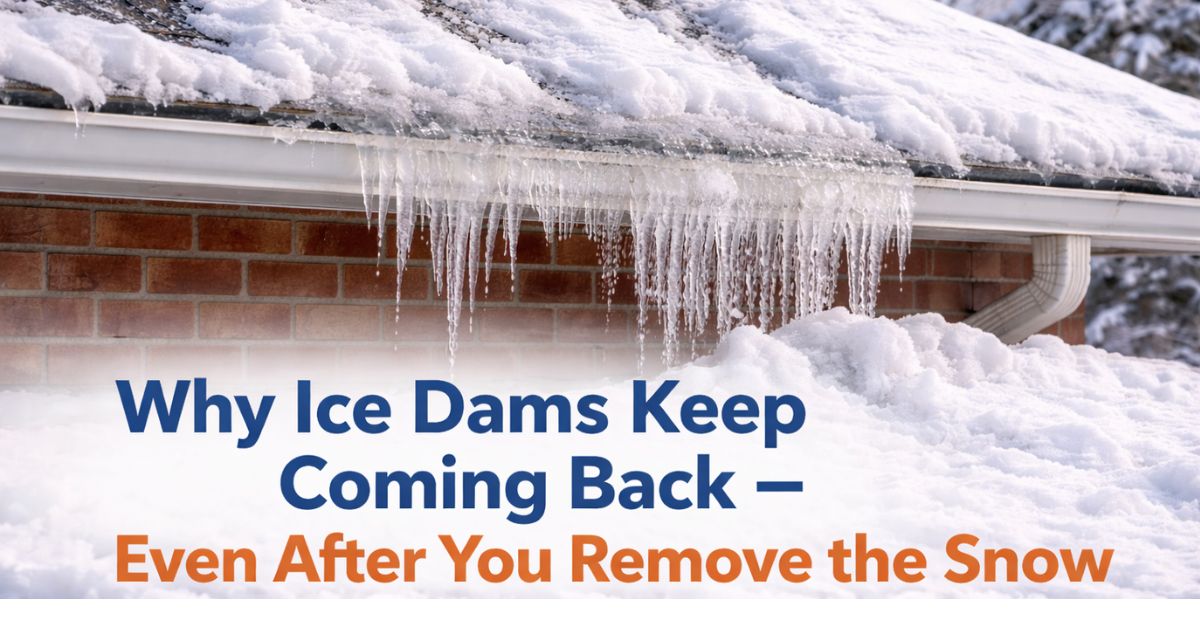
An ice dam forms when snow melts on the upper portion of a roof, flows downward, and refreezes at the colder roof edges. As this ice builds up, it traps water behind it. That trapped water has nowhere to go except under shingles and into the roof system.
The key detail most homeowners miss is this:
Snow doesn’t melt on a roof unless heat is escaping from below.
Why snow removal doesn’t stop ice dams
Removing snow only removes the raw material. It does nothing to stop the heat that caused the snow to melt in the first place.
If warm air continues escaping into the attic:
- Snow will continue melting unevenly
- Ice will reform at roof edges
- Water will continue backing up
- Leaks will still occur
Snow removal is a temporary relief, not a solution.
The real cause: attic heat loss
Ice dams begin inside your home, not on your roof.
Warm air rises naturally. In winter, heated air from your living space moves upward through:
- Ceiling penetrations
- Attic access doors
- Light fixtures
- Bathroom fan housings
- Chimney chases
- Gaps in insulation
Once this warm air enters the attic, it heats the roof deck from below. Snow melts where the roof is warm, then refreezes where the roof remains cold — usually at the eaves and gutters.
This process continues no matter how many times snow is removed.
Why ice dams come back on the same houses every year
You may notice that some homes on your street never get ice dams, while others get them every winter. That’s not coincidence.
Homes that repeatedly suffer ice dams often share these traits:
- Older construction
- Uneven or insufficient attic insulation
- Poor air sealing
- Inadequate ventilation
- Complex rooflines
- Brick construction that retains heat
Many St. Louis homes in neighborhoods like Clayton, University City, Kirkwood, Carondelet, Benton Park, and The Hill fit this profile.
The role of ventilation (and why it’s misunderstood)
Ventilation does not warm your attic — it removes excess heat and moisture.
A properly ventilated attic:
- Stays closer to outdoor temperature
- Reduces snow melt on the roof
- Prevents condensation
- Protects roof decking
Many homes either lack proper intake ventilation at the soffits, have blocked vents, or rely on outdated vent designs that no longer perform well.
Without balanced ventilation, heat becomes trapped — and ice dams return.
Why roof replacements don’t always fix ice dams
One of the most frustrating experiences homeowners face is replacing a roof, only to see ice dams return the following winter.
That happens because:
- Shingles don’t control attic heat
- New roofing materials don’t fix insulation gaps
- Roofers may not address ventilation or air sealing
- Ice & water shield protects against leaks, not ice formation
A roof replacement without attic evaluation treats symptoms, not causes.
The danger of recurring ice dams
Ice dams aren’t just an inconvenience. Over time, they can cause:
- Shingle deterioration
- Rotting roof decking
- Mold growth in insulation
- Fascia and soffit damage
- Gutter separation
- Interior ceiling and wall damage
Many homeowners don’t realize the damage until structural components are compromised.
Temporary measures vs permanent solutions
Temporary actions:
- Roof raking
- Snow removal
- Heat cables
- Gutter clearing
These reduce short-term risk but do not stop ice dams from forming.
Permanent solutions focus on:
- Air sealing attic leaks
- Proper insulation depth and coverage
- Balanced intake and exhaust ventilation
- Targeted ice & water shield installation
- Addressing roof design vulnerabilities
Stopping heat loss is the only way to break the cycle.
How professionals identify the real problem
A proper winter roof evaluation looks beyond the surface and includes:
- Attic temperature checks
- Insulation depth measurement
- Air leak identification
- Ventilation assessment
- Roof edge analysis
- Ice dam pattern tracking
This approach identifies why ice dams form — not just where.
The bottom line
If ice dams keep coming back, snow removal isn’t failing — it was never meant to solve the problem.
Ice dams are the visible warning sign of hidden heat loss. Until that heat is controlled, the cycle will repeat no matter how clean the roof looks.
Family First Exteriors helps St. Louis homeowners break the ice dam cycle by addressing the root causes — not just the symptoms. If you’ve dealt with ice dams more than once, it’s time to stop reacting and start fixing the real issue.