
March 25, 2026
When Should You Replace Your Windows? Energy and Comfort Signs for St. Louis Homes
Windows are one of those home features you interact with every single day without really thinking about them. You open them, close them, glance through them on your way to the coffee maker. But the moment they stop performing—when a draft sneaks in during a January cold snap, when your energy bill spikes for the third month in a row, when you can hear every car that passes on the street as if it’s in your living room—that’s when you start to realize just how much your windows affect daily life in your home.
For homeowners across the greater St. Louis area, window performance is tested year-round. Summer heat and humidity push cooling systems to their limits. Winter brings sub-zero wind chills that expose every weakness in an aging window seal. And the spring and fall temperature swings—where it’s 40°F at dawn and 75°F by afternoon—put constant stress on frames, weatherstripping, and glass units.
So how do you know when your windows just need some maintenance versus when it’s time for a full replacement? Here’s what to look for.
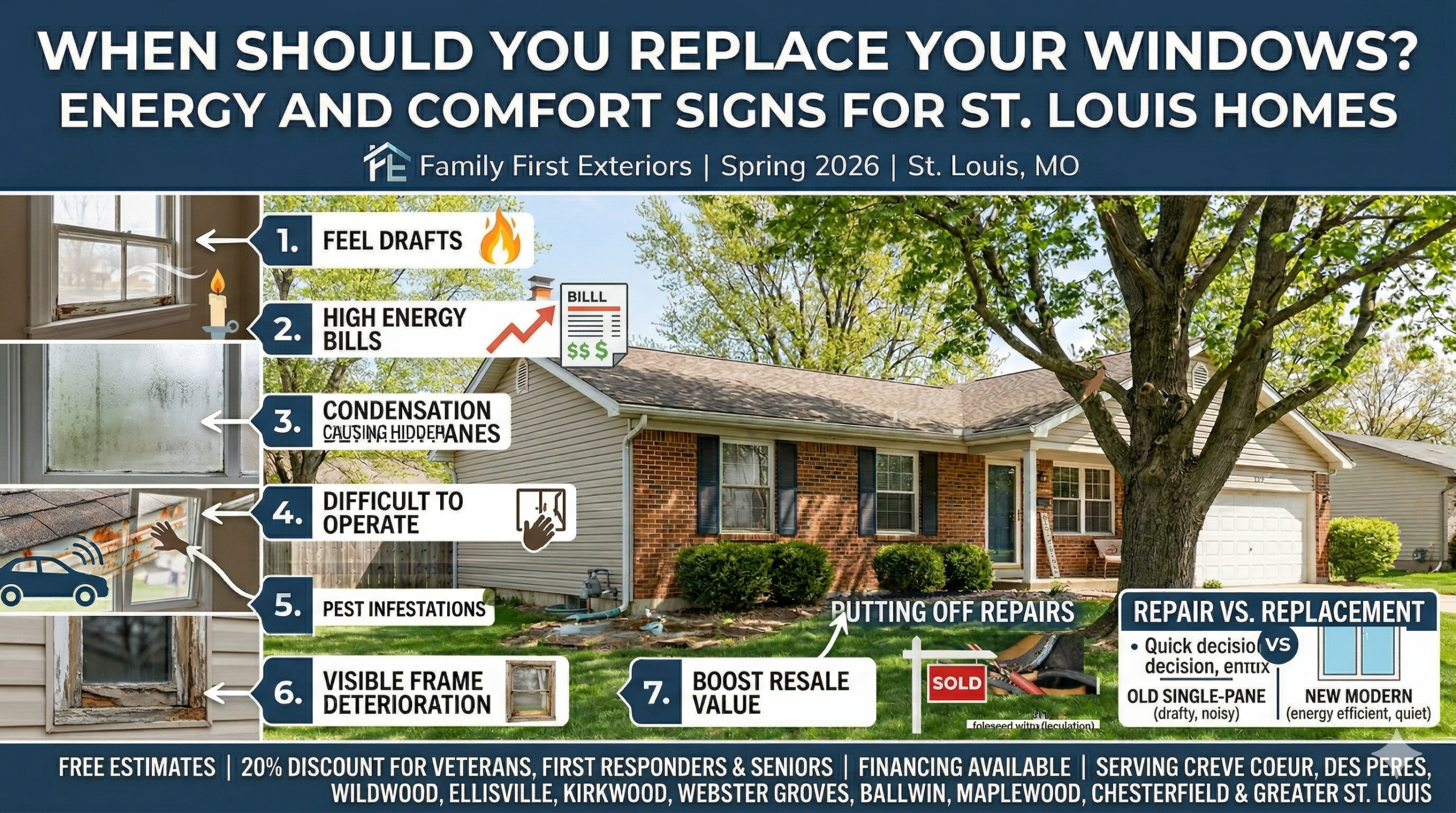
1. You Feel Drafts Even When the Windows Are Closed
This is the most common complaint we hear from St. Louis homeowners considering replacement windows, and it’s usually the first sign that something has changed. If you can feel cold air moving near a closed window during winter, or warm air seeping in during summer, the window’s seal has likely failed.
On older single-pane windows—still found in many homes across Kirkwood, Webster Groves, Maplewood, and other established St. Louis neighborhoods—drafts are practically unavoidable because the technology simply wasn’t designed for the level of energy efficiency we expect today. But even double-pane windows can develop drafts over time as the seals degrade, the weatherstripping compresses, and the frames warp from years of thermal expansion and contraction.
A quick test: on a windy day, hold a lit candle or a thin strip of tissue paper near the edges of a closed window. If the flame flickers or the paper moves, air is getting through. Do this on several windows around the house to get a sense of whether the problem is isolated or widespread.
2. Your Energy Bills Keep Climbing
Windows account for a significant portion of a home’s energy loss. According to the U.S. Department of Energy, heat gain and loss through windows is responsible for 25 to 30 percent of residential heating and cooling energy use. In a climate like St. Louis—where you’re running the furnace from November through March and the air conditioning from May through September—that percentage translates into real dollars on every utility bill.
If your energy costs have been trending upward and you’ve already ruled out HVAC issues, insulation problems, and rate increases from your utility provider, your windows are a likely culprit. This is especially true for homes with original single-pane windows or early double-pane units from the 1990s, when low-E coatings and argon gas fills weren’t yet standard.
Modern replacement windows with double or triple pane glass, low-emissivity coatings, and insulating gas fills can dramatically reduce energy transfer. Many St. Louis homeowners who upgrade from older windows see a noticeable improvement in both comfort and monthly energy costs within the first billing cycle after installation.
3. Condensation Between the Glass Panes
If you see fog, moisture, or a milky haze trapped between the panes of a double- or triple-pane window, the insulating seal has failed. This is different from condensation on the interior surface of the glass (which is usually a humidity issue inside the home) or condensation on the exterior surface (which is actually a sign that the window is insulating well).
Condensation between the panes means the argon or krypton gas that provides insulation has leaked out and been replaced by regular air, which also carries moisture. Once this happens, the window’s insulating value drops significantly, and the fogging will only get worse over time. There’s no way to reseal the unit or refill the gas—the entire insulated glass unit (or in most cases, the whole window) needs to be replaced.
This is a particularly common issue on windows that face south and west in St. Louis homes. Those exposures receive the most direct sun, which accelerates seal degradation through repeated thermal cycling.
4. Windows Are Difficult to Open, Close, or Lock
Windows that stick, jam, won’t stay open, or refuse to lock properly aren’t just an annoyance—they’re a safety and security concern. This problem is common with older wood-frame windows that have swollen from moisture absorption, painted-shut sashes, or worn-out balance mechanisms in single- and double-hung designs.
In St. Louis’s humid summers, wood-frame windows can swell enough to become virtually inoperable, and then shrink back in winter, leaving gaps. This seasonal cycle of swelling and shrinking gradually degrades the frame’s structural integrity and makes consistent operation impossible. If you find yourself forcing windows open with a putty knife or propping them up with a stick, those windows are well past the point of practical repair.
Modern vinyl and fiberglass replacement windows are engineered to resist moisture absorption and thermal warping, which means they operate smoothly regardless of the season—something St. Louis homeowners learn to appreciate quickly.
5. Excessive Outside Noise
If you can clearly hear traffic, lawn mowers, barking dogs, or conversations happening outside when your windows are closed, your windows aren’t providing adequate sound insulation. Single-pane windows offer almost no noise reduction, and older double-pane windows with failed seals aren’t much better.
This is a quality-of-life issue that homeowners in busier St. Louis corridors—along Manchester Road, near Highway 40/I-64, or in neighborhoods adjacent to Lambert Airport flight paths—notice acutely. Replacement windows with insulated glass and tight-fitting frames make a dramatic difference in interior noise levels. It’s one of the upgrades that homeowners consistently say they wish they’d done sooner.
6. Visible Frame Deterioration
Take a close look at your window frames, both inside and outside. Wood frames that show signs of rot, softness, or crumbling are beyond the point of cosmetic repair—once rot takes hold in a window frame, it compromises the structural support for the glass unit and creates pathways for water to enter the wall cavity.
Vinyl frames can also deteriorate, though the failure mode is different. Look for warping, cracking, discoloration that won’t clean off, or sections that feel brittle to the touch. Older vinyl formulations were more susceptible to UV degradation, and after 20 or more years of St. Louis sun exposure, the material can lose its structural properties.
Aluminum frames—common in homes built during the 1960s and 1970s across St. Louis County—are extremely durable but are poor insulators. If your home still has original aluminum-frame windows, replacing them with modern insulated vinyl or fiberglass frames can yield significant energy savings even if the aluminum frames themselves are in decent physical condition.
7. You’re Planning to Sell (or Want to Protect Resale Value)
Replacement windows consistently rank among the highest-ROI home improvement projects in national remodeling cost-vs-value reports. In a competitive real estate market like St. Louis, updated windows signal to buyers that the home has been well maintained and that they won’t inherit major energy or comfort problems.
Even if you’re not planning to sell anytime soon, new windows improve your daily living experience while building equity. Unlike a kitchen remodel or a bathroom renovation, window replacement delivers returns you feel every single day through lower energy bills, better comfort, and reduced outside noise.
What to Look for in Replacement Windows
Not all replacement windows are created equal, and the right choice depends on your home’s specific needs, your budget, and your priorities. Here are the key factors to consider:
- Glass type: Double-pane is standard for most applications, but triple-pane offers superior insulation and noise reduction for homeowners willing to invest more. Low-E coatings are essential for reducing UV transfer and protecting interior furnishings from fading.
- Frame material: Vinyl is the most popular choice for replacement windows in the St. Louis market due to its durability, low maintenance, and strong insulating properties. Fiberglass is a premium option that offers even greater strength and dimensional stability. Wood interiors with vinyl or aluminum cladding exteriors combine traditional aesthetics with weather resistance.
- Gas fill: Argon gas between the panes is standard and provides a meaningful insulation boost over regular air. Krypton gas is denser and more effective but adds cost—it’s typically used in triple-pane configurations.
- Installation quality: Even the best window won’t perform if it’s installed poorly. Proper flashing, insulation around the frame, and a weathertight seal are as important as the window itself. This is where working with an experienced installer makes the biggest difference.
Making Window Replacement Affordable
We understand that replacing windows across an entire home is a significant investment. That’s why Family First Exteriors offers financing options to every eligible homeowner, allowing you to budget the project in a way that works for your family. You don’t have to replace every window at once—many homeowners start with the most problematic rooms or the windows on the most weather-exposed sides of the house and plan additional phases over time.
We also offer a 20% discount to veterans, first responders, and senior citizens on all of our services, including replacement windows. If you or someone in your household qualifies, let us know when you schedule your estimate.
Your Windows Work Harder Than You Think
Every window in your home is part of the building envelope—the barrier between your conditioned living space and everything the St. Louis climate throws at it. When that barrier weakens, you feel it in drafts, hear it in outside noise, see it in foggy glass, and pay for it on every utility bill.
If any of the signs in this guide sound familiar, it’s worth getting a professional assessment. Family First Exteriors provides free in-home estimates for replacement window projects throughout the greater St. Louis area. We’ll evaluate your current windows, discuss your priorities, walk you through your options, and give you a straightforward quote with no hidden fees or pressure to commit on the spot.
Schedule a Free Window Replacement Estimate
Contact Family First Exteriors today at familyfirstexteriors.com/contact-us
Financing available | 20% discount for veterans, first responders & seniors
Serving Creve Coeur, Des Peres, Wildwood, Ellisville, Kirkwood, Webster Groves, Ballwin, Maplewood, Chesterfield, and the entire greater St. Louis metro area.