
February 19, 2026
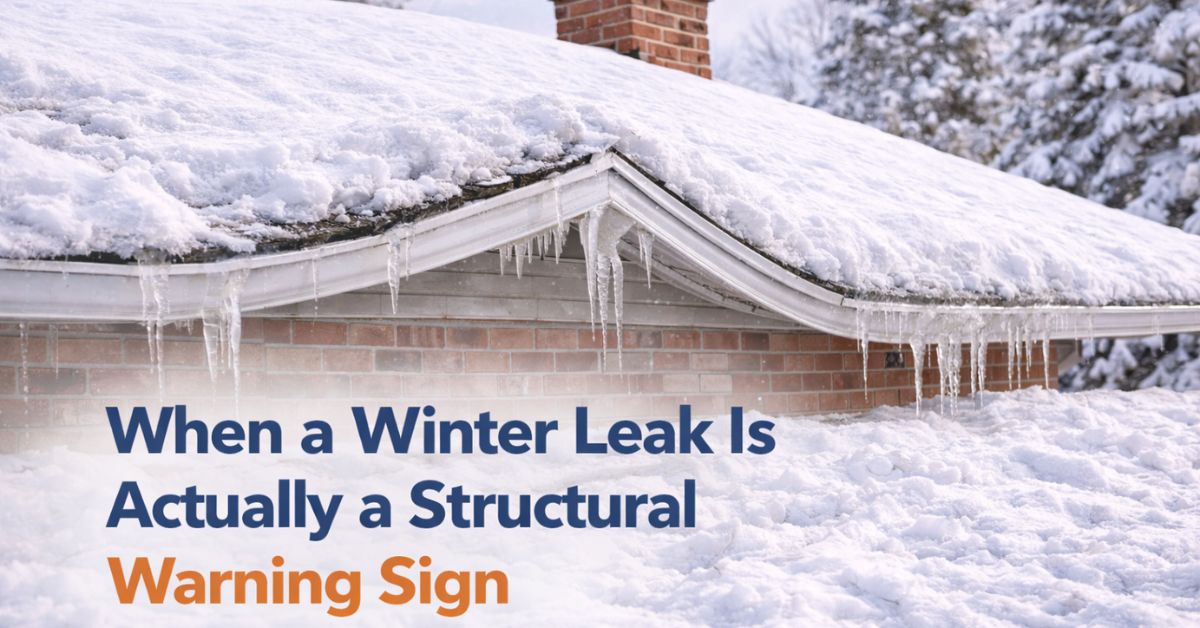
When a Winter Leak Is Actually a Structural Warning Sign
A small brown ceiling stain in January does not always mean “minor roof leak.”
Sometimes it means your roof structure is under stress.
In St. Louis, winter leaks often expose deeper structural problems that have been developing quietly for years. Freeze–thaw cycles, snow loads, attic heat imbalance, and moisture intrusion can slowly weaken the components that actually hold your roof together.
By the time water shows up inside, the problem may no longer be cosmetic.
Let’s break down when a winter leak is more than just a leak.
Winter Leaks Behave Differently
Summer leaks are usually straightforward:
- Storm damage
- Missing shingles
- Cracked flashing
- Wind-lifted tabs
Winter leaks are different.
They often involve:
- Ice dams
- Repeated freeze–thaw expansion
- Attic condensation
- Heavy snow weight
- Water backing up beneath materials
That combination does more than allow water inside. It stresses structural components.
The Roof System Most Homeowners Never See
Your roof is not just shingles.
Underneath are:
- Roof decking (sheathing)
- Rafters or trusses
- Ridge board
- Collar ties
- Fasteners
- Framing connections
These components carry the full weight of:
- Snow loads
- Ice accumulation
- Roofing materials
- Wind uplift
When water repeatedly infiltrates the decking, those structural elements begin to weaken.
How Freeze–Thaw Cycles Damage Structure
Water expands when it freezes.
If moisture enters roof decking or framing and temperatures drop below freezing, expansion occurs inside the material.
This leads to:
- Micro-fractures in wood fibers
- Delamination of OSB sheathing
- Fastener loosening
- Warped decking panels
In St. Louis, temperatures often fluctuate between the teens and the 40s within days. That constant expansion and contraction accelerates structural fatigue.
You may only see a ceiling stain.
But above that stain, the decking may already be softening.
Snow Load Can Reveal Hidden Weakness
Heavy, wet snow weighs significantly more than dry powder.
In winters with repeated accumulation, the weight compounds.
If your roof structure already has:
- Compromised decking
- Undersized framing
- Past water damage
- Improper repairs
The added snow load can cause:
- Subtle ridge sag
- Uneven roof lines
- Slight dips between rafters
- Creaking or shifting sounds
These are early structural warning signs.
Sagging Is Rarely Sudden
Most homeowners assume structural failure happens dramatically.
In reality, it is gradual.
Look for:
- Slight bowing along the ridge
- Depressions near valleys
- Ceiling drywall cracks
- Doors sticking during winter months
- New nail pops
These often indicate movement in the framing system.
And movement often begins with moisture.
Why Ice Dams Accelerate Structural Damage
Ice dams trap water on your roof.
When water backs up beneath shingles and remains there for days or weeks, the decking absorbs moisture repeatedly.
Even treated sheathing has limits.
Over time, saturated decking:
- Loses rigidity
- Weakens fastener grip
- Softens around nails
- Allows shingles to shift
When spring arrives, the visible ice is gone.
But the structural stress remains.
Attic Condensation Is a Silent Structural Threat
Warm air rising into a cold attic condenses on the underside of the roof deck.
This often goes unnoticed.
Over multiple winters, condensation can:
- Rot decking
- Promote mold growth
- Rust fasteners
- Soften framing joints
Because this damage occurs from inside the attic, exterior roof inspections may not detect it.
Yet structurally, the system is deteriorating.
Brick Homes Add Additional Stress
In older St. Louis brick homes — especially in neighborhoods like Soulard, Tower Grove, Carondelet, and Bevo Mill — structural movement is more common due to:
- Settling foundations
- Balloon framing
- Moisture migration through masonry
- Added roof layers over decades
If flashing around chimneys or parapets fails, water can travel into framing connections where brick meets roof structure.
That interface is often overlooked.
But it is a critical structural junction.
When a Leak Indicates Decking Failure
Warning signs that a winter leak may involve structural compromise include:
- Persistent leaks in the same location year after year
- Soft spots when walking on the roof
- Shingles that feel spongy
- Sagging visible from the street
- Darkened or warped attic decking
- Fasteners pulling through sheathing
If water has repeatedly saturated decking, replacement may be required — not just repair.
The Cost of Ignoring Structural Signals
Cosmetic repairs might cost a few hundred dollars.
Structural roof repairs can reach several thousand.
Left unchecked, structural damage can lead to:
- Full deck replacement
- Framing reinforcement
- Interior ceiling reconstruction
- Mold remediation
- Reduced property value
The longer moisture affects load-bearing elements, the more complex the solution becomes.
Why Winter Is the Best Time to Catch It
Winter actually makes structural weaknesses easier to identify.
Snow highlights sag patterns.
Ice dams reveal heat imbalance.
Temperature swings expose weak connections.
Leaks during freeze–thaw cycles show stress points.
If you wait until spring, many of these indicators disappear temporarily.
But the structural fatigue does not reverse itself.
What a Structural-Focused Roof Inspection Should Include
If a winter leak occurs, inspection should go beyond shingles.
It should evaluate:
- Roof deck integrity
- Framing straightness
- Ridge alignment
- Fastener condition
- Attic moisture levels
- Insulation distribution
- Ventilation performance
- Flashing transitions at structural junctions
Thermal imaging can identify moisture trapped inside decking.
Attic examination can reveal rot before collapse risk develops.
The Difference Between Cosmetic and Structural Leaks
Cosmetic leak:
- One-time intrusion
- Surface flashing issue
- Easily repaired
Structural warning sign:
- Repeated seasonal leaks
- Visible roofline changes
- Soft decking
- Persistent ice dam zones
- Moisture patterns inside attic
Understanding that difference protects your long-term investment.
Why This Matters in St. Louis
Our winters are not steady and predictable.
They are volatile.
Repeated thawing and refreezing places more structural stress on roofing systems than constant cold climates.
Combined with older housing stock and decades of modifications, many homes carry hidden weaknesses.
Winter leaks are often the first visible signal.
The Bottom Line
A winter leak is not always just a leak.
It can be your roof telling you that the structure underneath is under stress.
Ignoring that signal may allow minor decking damage to become major structural repair.
If you notice winter leaks, sagging lines, repeated ice buildup, or soft roof areas, it may be time for a structural-focused evaluation — not just another patch.
Family First Exteriors performs comprehensive roof inspections throughout St. Louis that assess both surface materials and underlying structure.
If you suspect your winter leak could be more than cosmetic, call (314) 255-8151 for a full evaluation before the next freeze cycle compounds the damage.