
July 15, 2026
Why Is My Roof Leaking with No Storm Damage? 7 Non-Weather Causes St. Louis Homeowners Miss
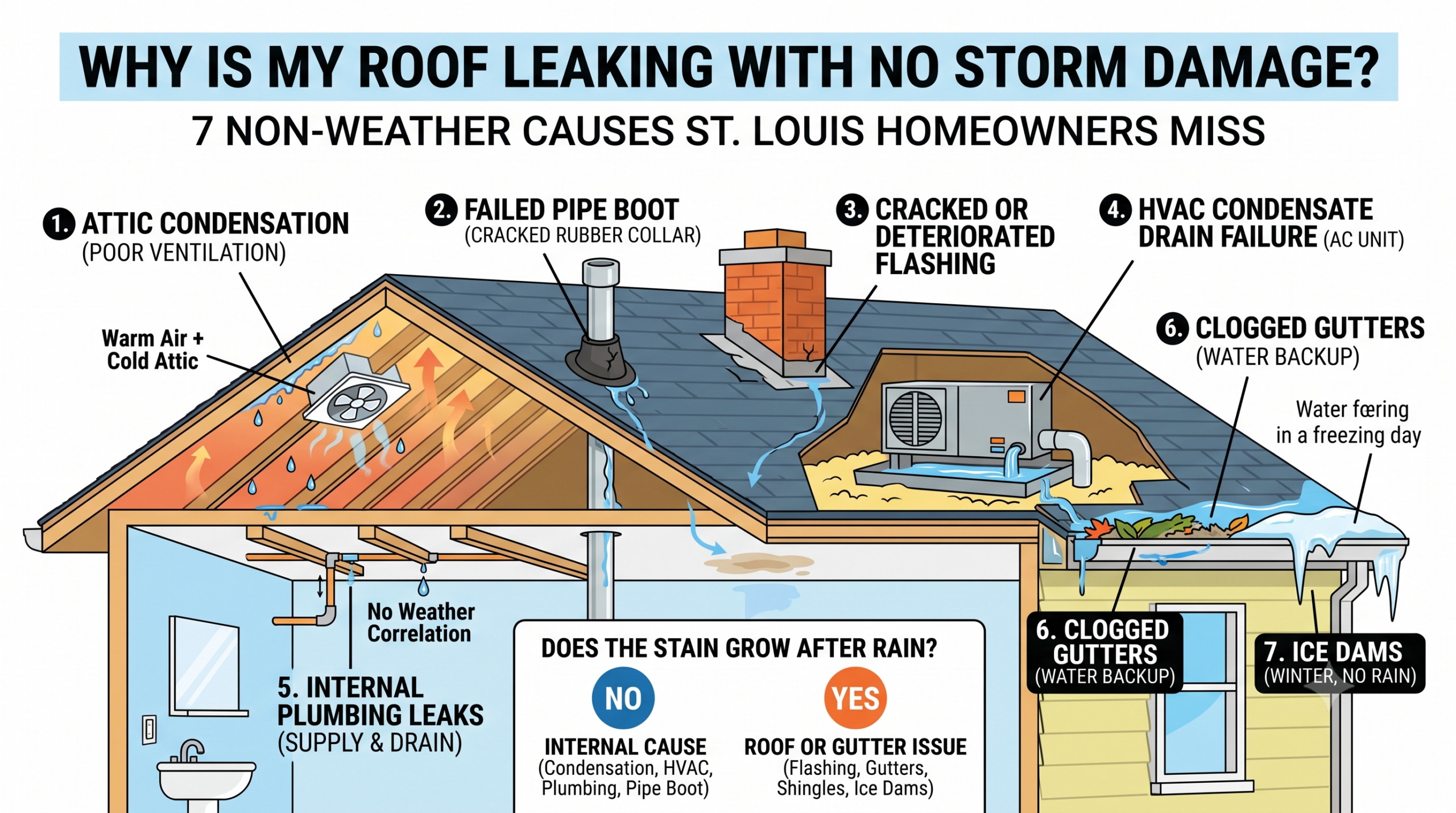
Not every roof leak starts with a storm. In fact, some of the most damaging leaks in St. Louis homes have nothing to do with wind, hail, or rain. Attic condensation, failed pipe boots, cracked flashing, HVAC condensate line failures, and plumbing leaks can all produce ceiling stains, dripping water, and attic moisture that look identical to storm damage. The diagnostic test is simple: does the stain grow after rain? If it does, the leak is likely tied to the roof or gutter system. If it appears in dry weather or has no correlation with storms, the cause is usually internal. Here are the seven most common non-weather causes of roof leaks and how to tell them apart.
1. Attic Condensation from Poor Ventilation
This is the most common reason a roof appears to leak without rain. When warm, moist air from inside your home rises into a cold attic, it condenses on the underside of the roof deck, much like a cold glass sweats on a humid day. That condensation drips onto insulation, rafters, and ceiling joists, producing stains and moisture that look exactly like an active roof leak.
The giveaway: condensation tends to distribute broadly and evenly across surfaces. A true roof leak concentrates around penetrations and follows a downward path from a specific entry point. Condensation also appears or worsens during cold weather regardless of whether it has rained.
Common causes in St. Louis homes include bathroom exhaust fans that vent into the attic instead of to the exterior, blocked soffit vents (especially in older Ballwin, Kirkwood, and Webster Groves homes where blown-in insulation has covered the soffits), and missing or inadequate ridge ventilation. The fix is a ventilation assessment and correction, not a roof repair.
2. Failed Pipe Boots
Every plumbing vent that penetrates the roof has a rubber collar (pipe boot) that seals around the pipe. These boots degrade from UV exposure on a predictable schedule: neoprene collars crack after 10 to 15 years, EPDM collars last 15 to 20 years, and silicone collars last 25 to 40 years. When the collar cracks, water follows the outside of the pipe straight down into the attic.
Pipe boot leaks are easy to diagnose because the ceiling stain is almost always directly below a plumbing vent pipe, typically in a bathroom ceiling, above a kitchen cabinet, or in a utility closet. The repair costs $250 to $500 including the service call, and the boot itself costs $15 to $60.
3. Cracked or Deteriorated Flashing
Flashing is the metal that seals the joints around chimneys, skylights, vents, and valleys. It fails from corrosion, sealant breakdown, and thermal movement as the roof and the surface it meets expand and contract at different rates. Once flashing lifts or cracks, water has a direct path into the roof deck.
Flashing leaks are tricky because water travels along the decking and rafters before it drips through the ceiling. A flashing gap at your chimney can produce a ceiling stain six feet away near a light fixture. Homeowners who patch only the stained drywall without tracing the path upslope will see the same leak return with the next rain.
4. HVAC Condensate Drain Failure
Your air conditioning system produces condensation as part of normal operation. If the unit is located in the attic or routes ductwork through it, a clogged condensate drain line or cracked drain pan can release water that pools and drips through the ceiling. This looks exactly like a roof leak but has nothing to do with the roof.
The giveaway: the stain appears mainly during hot weather when the AC is running hard, not during rain. If your ceiling stain is directly below the attic air handler and shows up in summer, the HVAC system is a prime suspect. A plumber or HVAC technician handles this repair, not a roofer.
5. Plumbing Leaks Mimicking Roof Leaks
Pipes running through walls and above ceilings can produce stains identical to roof leaks, especially near bathrooms and kitchens. A slow drip from a supply line, drain connection, or fitting can wet the ceiling framing for weeks before a visible stain appears.
The giveaway: a plumbing leak does not care about the weather. A pressurized supply line drips steadily whether it has rained or not. If the stain gets worse when someone runs a faucet, flushes a toilet, or takes a shower, the source is plumbing, not the roof.
6. Clogged Gutters Causing Water Backup
When gutters fill with leaves and debris, water cannot drain properly. It pools at the roofline, backs up under the shingles at the eaves, and seeps into the fascia board and soffit. Over time, this creates rot and moisture intrusion that produces ceiling stains near the exterior walls of upper floors.
This is technically weather-related (it requires rain), but it is not storm damage. Insurance typically does not cover damage from maintenance neglect. Cleaning gutters twice a year ($150 to $300) prevents this entirely.
7. Ice Dams (Winter, No Rain Needed)
Ice dams form when heat escaping from a poorly ventilated attic melts snow on the upper roof. The meltwater flows toward the cold eaves, refreezes, and creates a ridge of ice that traps water behind it. That trapped water backs up under the shingles and into the home. This happens on freezing, rain-free days. St. Louis gets enough winter precipitation and freeze-thaw cycling to make ice dams a recurring concern, especially on north-facing slopes and in neighborhoods with heavy tree canopy.
How Do I Figure Out Which Cause Applies to My Home?
| Clue | Most Likely Cause |
|---|---|
| Stain grows after rain | Flashing, shingle, or gutter failure |
| Stain appears in cold weather, no rain correlation | Attic condensation or ice dams |
| Stain appears in hot weather when AC runs | HVAC condensate drain failure |
| Stain is directly below a plumbing vent pipe | Failed pipe boot ($250-$500 fix) |
| Stain near bathroom/kitchen, worse during water use | Plumbing leak (call a plumber) |
| Stain near exterior wall on upper floor | Clogged gutters causing backup |
| Moisture spread broadly across attic surfaces | Ventilation/condensation issue |
A professional roof inspection can identify the true source. Family First Exteriors evaluates the roof, attic, ventilation, and penetrations together so you get the right diagnosis and the right repair, not a guess.
About Family First Exteriors
Family First Exteriors, LLC diagnoses and repairs all types of roof leaks across the greater St. Louis area. Also handles storm damage and insurance claims, siding, gutters, and windows. Since 2002. 20% discount for veterans, first responders, seniors. Financing available.
15009 Manchester Rd, Ste 261, Ballwin, MO 63011
Phone: (314) 255-8151
Request a Free Estimate
Frequently Asked Questions
Why is my roof leaking when there is no storm?
The most common non-storm causes are attic condensation from poor ventilation, failed rubber pipe boots around plumbing vents, cracked or deteriorated flashing, HVAC condensate drain failures, plumbing leaks above the ceiling, clogged gutters causing water backup, and ice dams in winter. A professional inspection identifies the true source.
How can I tell if my ceiling stain is a roof leak or condensation?
The key diagnostic test: does the stain grow after rain? If yes, it is likely a roof or gutter issue. If the stain appears in cold weather with no rain correlation, or spreads broadly across attic surfaces, it is more likely condensation from poor attic ventilation. Condensation distributes evenly; roof leaks concentrate around specific penetrations.
How long do pipe boots last on a roof?
Neoprene pipe boots typically crack after 10 to 15 years. EPDM boots last 15 to 20 years. Silicone boots last 25 to 40 years. All degrade from UV exposure well before the surrounding shingles reach end of life. Pipe boots should be replaced during every roof replacement and inspected every 5 years starting at year 8.
Can my HVAC system cause what looks like a roof leak?
Yes. If your air conditioning unit is in the attic or routes ductwork through it, a clogged condensate drain or cracked drain pan can release water that drips through the ceiling. The giveaway is that the stain appears mainly during hot weather when the AC runs hard, not during rain events.
Does homeowners insurance cover non-storm roof leaks?
Generally no. Standard homeowners insurance covers sudden damage from storms, fallen trees, and similar events. Leaks caused by gradual wear, poor maintenance, aging materials, condensation, or plumbing failures are typically excluded. Maintaining your roof and addressing small repairs promptly is the best protection against uncovered damage.
How much does it cost to fix a non-storm roof leak?
It depends on the cause. A pipe boot replacement runs $250 to $500. Flashing repair costs $300 to $1,000. Gutter cleaning is $150 to $300. A ventilation correction during a roof replacement costs $400 to $1,200. HVAC and plumbing repairs vary but are handled by those respective trades, not a roofer.
Leak with No Storm? Get the Right Diagnosis.
Family First Exteriors inspects the roof, attic, ventilation, and penetrations together. Free estimates throughout St. Louis.
(314) 255-8151 | Request Your Free Inspection Online
Serving Ballwin, Kirkwood, Webster Groves, Creve Coeur, Chesterfield, Wildwood, and the entire St. Louis metro. 20% discount for veterans, first responders, and seniors.