
March 5, 2026
Hidden Roof Damage from the April 2025 Hailstorm: What St. Charles County Homeowners Are Just Now Seeing
It has been roughly a year since severe spring weather swept across St. Charles County. While neighborhoods in Dardenne Prairie and Cottleville—including popular subdivisions like Windsor Place and Timberwood Trails—managed to avoid the catastrophic tornadoes that struck the broader metro area later in the season, they did not escape the weather entirely.
In April 2025, powerful thunderstorm systems battered the region, dropping hailstones that measured 1.5 inches in diameter across St. Charles County. Today, a year later, many local homeowners are experiencing unexplained leaks, excessive shingle shedding, and sudden drafts. The culprit isn’t a new storm; it is the delayed, hidden destruction from April 2025.
Here is a deep dive into the physics of why your roof might be failing right now, and why you must act before your insurance claim window closes forever.
The Illusion of a “Fine” Roof
After the April 2025 hail subsided, many homeowners walked outside, looked up at their roofs, and assumed everything was fine. There were no gaping holes, and the living room ceiling was dry.
However, 1.5-inch hail is large enough to create severe micro-bruising in your asphalt shingles, dent your flashing, and compromise your gutter systems. When hail strikes a roof, it forcefully dislodges the protective top layer of granules and bruises the asphalt matting underneath. Initially, this damage is virtually invisible from the ground. It weakens the structural integrity of the shingle but doesn’t immediately let water into your home. This gives homeowners a false sense of security.
The Multiplier Effect: Missouri’s Freeze-Thaw Cycle
The real destroyer of a hail-damaged roof isn’t just the initial impact—it is the brutal Missouri winter that follows.
Missouri is located in a climate “sweet spot” for roof destruction, averaging between 30 to 50 freeze-thaw cycles every single winter. During a typical winter day in Cottleville or Dardenne Prairie, temperatures might reach 45°F, melting the ambient snow and ice. This meltwater easily seeps into the microscopic cracks, nail holes, and soft spots left behind by the April hail.
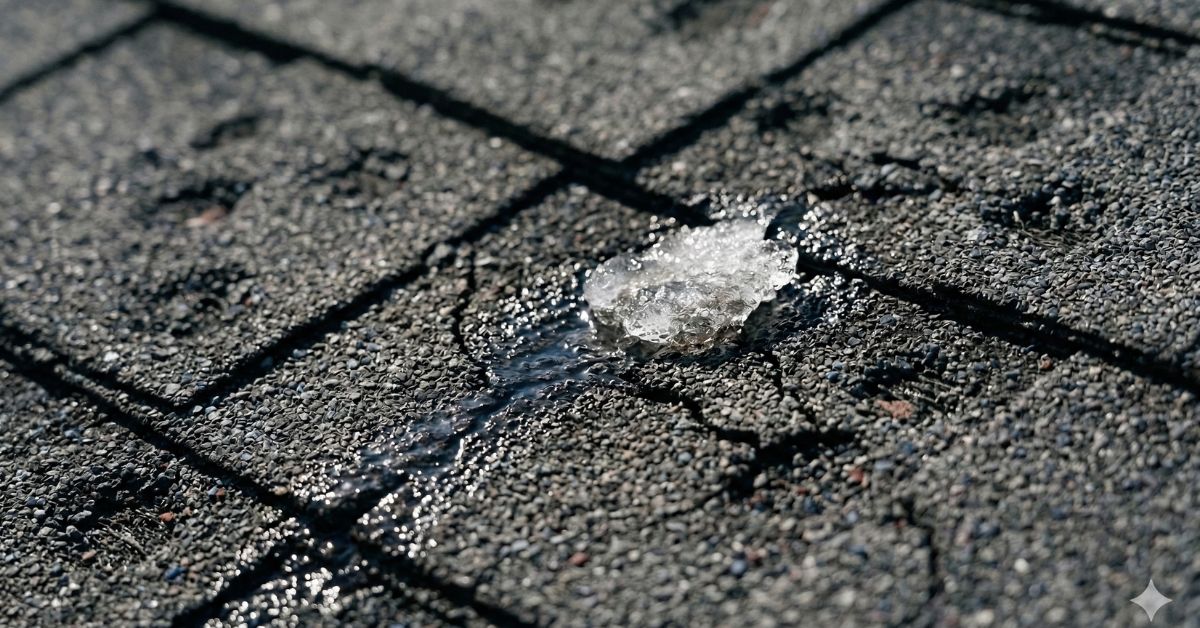
When the sun goes down and temperatures plummet below freezing, physics takes over. Water expands by exactly 9% when it freezes into ice. That trapped water expands inside the micro-cracks of your shingles, violently forcing those cracks wider.
Over 30 to 50 cycles, the damage multiplies exponentially. As the freeze-thaw cycle repeatedly attacks the hail-bruised areas, shingles begin to lift, nails are forced loose, and the protective granules shed at an accelerated rate. What your insurance adjuster might have originally dismissed as “minor cosmetic bruising” in the summer of 2025 has now been forced open by winter ice, escalating into full-blown structural failure.
Signs You Have Hidden Hail & Winter Damage
Now that the spring thaw is here, the hidden damage is beginning to reveal itself. St. Charles County homeowners should look for the following red flags:
- Granule Loss: If your gutters are suddenly filled with dark, sandy granules, the protective layer of your shingles has been scoured away by the weather cycle.
- Bald Spots: Areas on the roof that look unusually dark or slick indicate where the asphalt layer is completely exposed to the elements.
- Curling or Lifted Shingles: Moisture that penetrated the underlayment and froze will push shingles upward, breaking their waterproof seal.
- Subtle Interior Leaks: Faint yellow or brown water stains appearing on your second-floor ceilings or in the attic.
The Ticking Clock: Your Insurance Claim Window
Here is the most critical detail for homeowners in Dardenne Prairie and Cottleville: your window to get a full roof replacement covered by your homeowner’s insurance is closing rapidly.
In Missouri, most insurance policies dictate a strict one-to-two-year window from the exact “date of loss” (the date the storm occurred) to file a property damage claim. Because this specific severe hail event occurred in April 2025, your deadline to file a claim could be weeks away, depending on your carrier’s specific policy language.
If you wait until a visible leak destroys your drywall or causes mold growth, you might be forced to pay completely out-of-pocket for a full roof replacement, which averages between $12,000 and $18,000.
Protect Your Home Before Time Runs Out
Do not let the hidden damage from the April 2025 hailstorm become a massive financial burden this year. If your home was in the path of the storm, you need a professional to look for the specific markers of expanded hail damage.
At Family First Exteriors, we specialize in identifying hidden storm damage, documenting the scope of loss, and helping St. Charles County homeowners navigate the insurance claims process to get the full roof replacements they deserve.
Act before your claim window expires. Call our 24/7 team today at (314) 255-8151 to schedule a free, comprehensive roof inspection.