
February 19, 2026
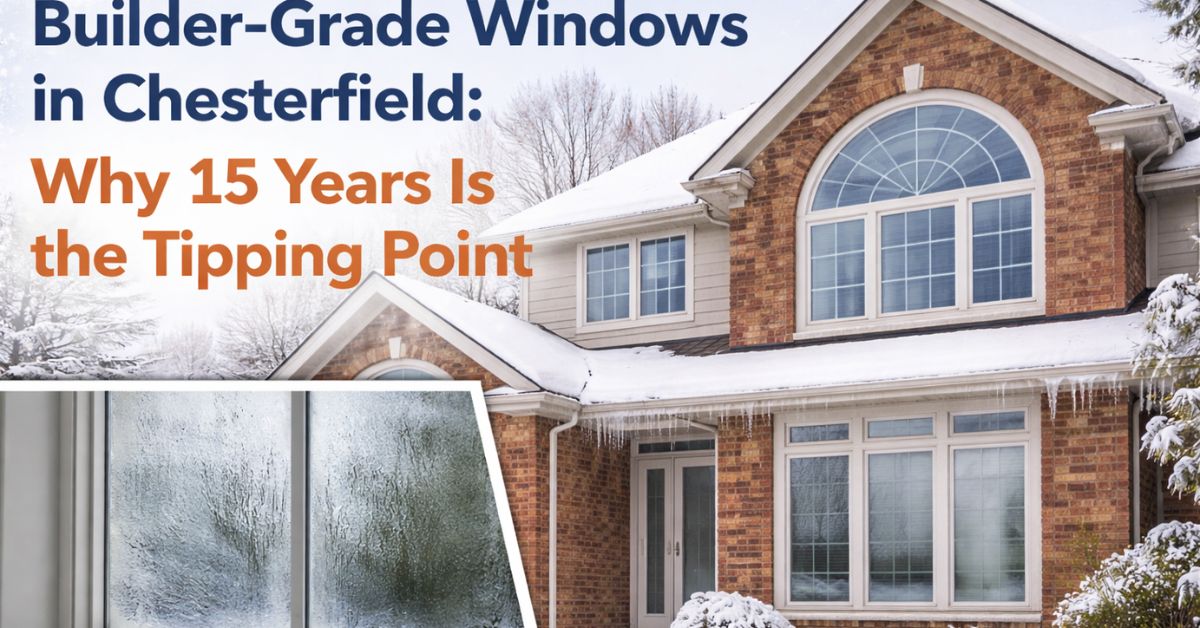
Builder-Grade Windows in Chesterfield: Why 15 Years Is the Tipping Point
If your Chesterfield home was built in the early 2000s, there’s a high chance your windows are approaching a critical age.
They may still open. They may still lock. They may even look fine from the street.
But if they are original builder-grade units, 15 years is often the tipping point where performance begins to decline — quietly at first, then rapidly.
Let’s break down why that happens and what Chesterfield homeowners should understand before problems escalate.
What “Builder-Grade” Really Means
Builder-grade does not mean defective.
It means cost-controlled.
In large subdivisions throughout Chesterfield — especially developments built between 1998 and 2010 — production builders installed windows designed to:
- Meet minimum energy codes
- Fit mass production timelines
- Stay within budget
- Provide acceptable short-term performance
These windows were not engineered for 30 to 40 years of high-performance durability.
They were engineered for affordability and code compliance.
There’s a difference.
Why 15 Years Is the Performance Cliff
Most builder-grade vinyl windows begin to show performance decline between years 12 and 18 due to:
- Seal degradation
- Frame expansion and contraction fatigue
- Hardware wear
- UV exposure
- Argon gas dissipation
- Weatherstrip breakdown
In Chesterfield’s climate, this timeline accelerates because of freeze–thaw stress and high summer heat.
Chesterfield’s Climate Is Hard on Windows
Chesterfield homes face:
- Hot, humid summers above 90°F
- Freezing winter nights in the teens
- Rapid temperature swings
- Intense afternoon sun exposure
- Heavy spring storms
Vinyl expands in heat and contracts in cold.
Over 15 years, that repeated expansion cycle weakens:
- Corner welds
- Frame rigidity
- Sealant joints
- Insulated glass seals
Eventually, small inefficiencies become noticeable problems.
The Early Warning Signs Most Homeowners Miss
Before visible damage occurs, subtle changes begin.
Look for:
- Slight drafts near window edges
- Increased heating bills
- Faint fogging between panes
- Windows that stick or resist locking
- Exterior caulking cracking
- Interior trim separation
These are not cosmetic issues.
They are structural fatigue signals.
The Glass Seal Failure Problem
Double-pane builder-grade windows rely on sealed insulated glass units (IGUs).
Inside that space:
- Argon gas improves insulation
- Desiccant absorbs moisture
- The seal keeps outside air out
Around year 15, the perimeter seal often weakens.
Once compromised:
- Argon escapes
- Moisture enters
- Fogging begins
- Insulation performance drops
Even if fogging is not visible yet, R-value has already declined.
Energy Loss Is the Hidden Cost
A failing window does not suddenly shatter.
It slowly becomes inefficient.
That inefficiency shows up as:
- Cold drafts in February
- Hot spots in July
- HVAC strain
- Higher utility bills
Many Chesterfield homeowners notice:
“The upstairs is always colder.”
Often, the windows are part of the reason.
Why Larger Chesterfield Homes Feel It More
Many Chesterfield properties feature:
- Two-story great rooms
- Large window walls
- Arched specialty windows
- Decorative transoms
- Multiple exposure sides
More glass equals more opportunity for heat transfer.
When builder-grade windows age in these larger openings, performance decline becomes more noticeable.
Especially on west-facing elevations that absorb afternoon sun.
Frame Movement and Structural Shift
Homes settle.
Over 15 years, minor structural movement occurs.
Builder-grade window frames often lack the rigidity to accommodate that movement long-term.
The result:
- Slight frame warping
- Air gaps
- Uneven locking pressure
- Water infiltration during heavy rain
Chesterfield’s clay-heavy soil contributes to subtle foundation shifts that can impact window alignment over time.
Why Caulking Alone Doesn’t Fix It
Many homeowners attempt to solve drafts with exterior caulk.
Caulking can temporarily reduce air leakage.
But it does not fix:
- Seal failure
- Frame flex
- Insulated glass breakdown
- Structural movement
Surface sealing addresses symptoms, not performance decline.
When Repair Makes Sense
Not every 15-year-old window needs full replacement.
Repair may be viable if:
- Hardware is the only issue
- Caulk has simply deteriorated
- Minor glass seal issues exist in limited units
But widespread fogging, frame flex, and energy inefficiency usually indicate systemic aging.
At that point, replacement becomes more cost-effective long term.
What Modern Windows Do Differently
Today’s performance windows include:
- Multi-chamber reinforced frames
- Improved Low-E coatings
- Warm-edge spacers
- Advanced seal technology
- Stronger corner welds
- Higher air infiltration ratings
Energy standards have improved dramatically since early 2000s installations.
The difference in thermal performance is measurable.
The Tipping Point Question
Ask yourself:
- Are multiple windows fogging?
- Are utility bills climbing without explanation?
- Are drafts noticeable during winter?
- Is condensation forming along edges?
- Are locks or sashes misaligned?
If yes, your windows may be crossing the tipping point.
Waiting too long can lead to:
- Water intrusion into framing
- Interior drywall damage
- Mold development
- Increased HVAC strain
Why Chesterfield Homeowners Should Act Before Failure
Window replacement is most efficient when planned.
Emergency replacement after water damage is more expensive.
February is often when homeowners notice:
- Drafts
- Cold glass
- Condensation
- Ice forming along interior frames
That discomfort is the early warning system.
The Long-Term Financial Perspective
Aging builder-grade windows cost you in:
- Utility waste
- Reduced home comfort
- Potential moisture damage
- Lower resale appeal
Strategic replacement:
- Improves energy efficiency
- Enhances curb appeal
- Increases property value
- Reduces HVAC load
In higher-value Chesterfield neighborhoods, updated windows are a visible upgrade.
The Bottom Line
Builder-grade windows were never designed for 30-year performance.
At 15 years, many begin transitioning from “functional” to “inefficient.”
If your Chesterfield home still has its original windows from early 2000s construction, this is the point where evaluation makes sense.
Replacement is not about appearance.
It is about performance, durability, and long-term efficiency.
Family First Exteriors provides professional window evaluations across Chesterfield and surrounding St. Louis communities. If your windows are nearing the 15-year mark, call (314) 255-8151 to schedule an assessment before minor inefficiencies become major problems.