
June 25, 2026
Should You Add Solar Panels During a Roof Replacement? What St. Louis Homeowners Need to Know
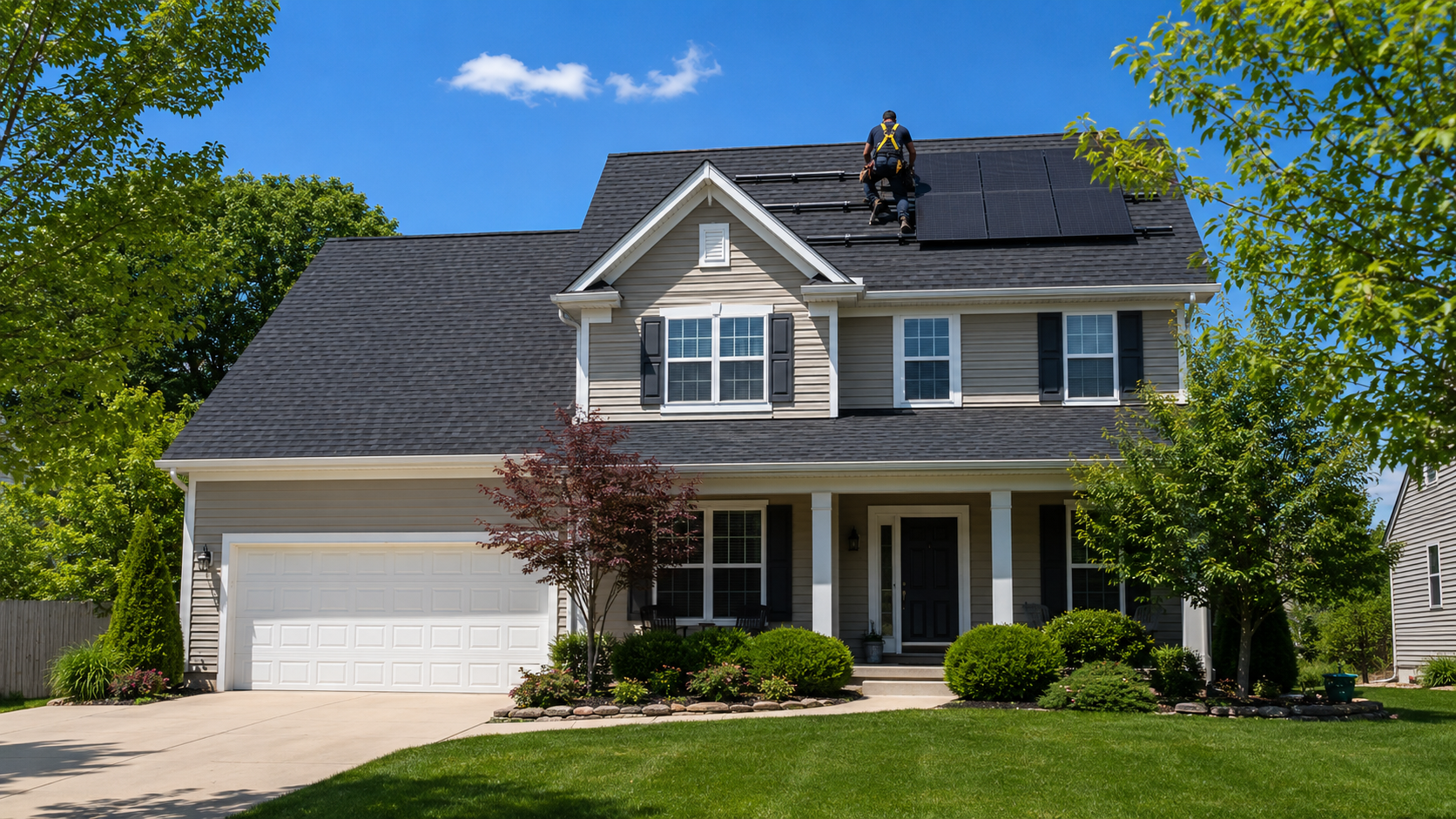
If your roof is more than 10 years old and you are considering solar panels, replace the roof first. Solar panels are designed to last 25 to 30 years. If your roof has 10 or fewer years left, you will need to remove the panels, replace the roof, and reinstall the panels mid-life, which costs $2,800 to $4,800 for a typical 14 to 16 panel system according to Fixr’s 2026 data. That is pure additional expense for labor you already paid for once. Replacing the roof before or at the same time as the solar installation avoids this entirely and can save $3,000 to $5,000 through bundled scheduling according to NREL research.
Why Does Roof Age Matter So Much for Solar Timing?
Solar panels are bolted to your roof through mounting hardware that penetrates the roofing material and attaches to the roof deck. Once installed, the panels cover a large portion of the roof surface, making it impossible to inspect or repair the shingles underneath without removing the entire array first.
If your shingles fail at year 15 while your solar panels are at year 5, you face a costly mid-life removal and reinstallation (R&R). The R&R process involves disconnecting the solar system from the electrical panel and grid, removing each panel (40 to 60 pounds each), removing the mounting rails and roof attachments, sealing every penetration point, storing the panels safely, completing the roof replacement, reinstalling all mounting hardware, reattaching and reconnecting every panel, and scheduling a final inspection and grid reconnection. This process takes 1 to 2 days for removal, 1 to 3 days for the roof, and 2 to 3 days for reinstallation. Total additional cost: $2,800 to $4,800 for 14 to 16 panels, and potentially $3,800 to $12,500 for larger or more complex systems.
ConsumerAffairs reports that this scenario is one of the most common complaints they receive from solar customers: homeowners who were not warned by their solar installer that the roof underneath needed replacement first.
How Much Does Solar Cost in Missouri in 2026?
The average Missouri home needs a 10 to 13 kW system to offset its electricity usage (based on Missouri’s average household consumption of 12,468 kWh per year). Here is what that costs:
| System Size | Cost Before Incentives | Payback Period |
|---|---|---|
| 5 kW | $17,100 | ~10 years |
| 9 kW | $25,200 to $30,600 | ~11 to 14 years |
| 12.8 kW (average need) | $27,100 to $36,700 | ~14 years |
Sources: EnergySage Missouri (2026), Green Energy Calculators (April 2026), PowerOutage.us (April 2026).
Important change for 2026: The federal 30% residential solar tax credit (Section 25D) expired on December 31, 2025, per Public Law 119-21. Missouri homeowners installing solar in 2026 no longer qualify for this credit. This significantly affects the payback math. Without the federal credit, a $28,000 system costs $28,000 out of pocket, not $19,600.
Missouri does still have net metering under RSMO Section 386.890. Ameren Missouri customers receive credit for excess solar generation at 5.39 cents per kWh in summer and 3.92 cents per kWh in winter, according to EnergySage. Evergy (Kansas City area) offers one-to-one net metering at full retail rates.
Should I Bundle My Roof Replacement and Solar Installation?
If your roof needs replacement within the next 5 years and you are planning solar, doing both at the same time makes strong financial sense. NREL (National Renewable Energy Laboratory) research shows bundling savings of $3,000 to $5,000 from a single mobilization, coordinated scheduling, and integrated mounting work done during the roof install rather than after.
Bundled projects also avoid the roof warranty complications that can arise when a separate solar installer penetrates a brand-new roof. When the same team (or coordinated teams) handle both, the flashing, sealant, and penetration work is done to the roofing manufacturer’s specifications from the start.
However, bundling is not always the right move. If your roof has 15 or more years of remaining life, there is no financial reason to replace it just to install solar. A qualified roofer can assess whether your existing roof can support solar for its remaining lifespan without issues. Family First Exteriors provides free roof inspections that include an assessment of remaining roof life, which is the first step in any solar timing decision.
Can Solar Panels Void My Roof Warranty?
Solar panels do not automatically void your roof warranty, but they can if installed improperly. The mounting hardware requires penetrations through the roofing material into the deck. If these penetrations are not sealed using the shingle manufacturer’s approved methods (correct flashing, approved sealant, proper placement relative to shingle overlap), the manufacturer can void warranty coverage on the affected area of the roof.
Three specific risks to watch for:
Wrong sealant. Some solar installers use generic caulk or silicone instead of the roofing manufacturer’s approved sealant product. This can void the shingle warranty around every mounting point.
Penetrations in the wrong location. Mounting bolts should go through the shingle and into the rafter, not just into the sheathing. They should also be placed to avoid disrupting the shingle’s water-shedding overlap pattern.
Installation on an aging roof. If your shingles are already past their expected lifespan, installing solar on top creates a situation where the warranty is likely already diminished, and the added weight and penetrations accelerate the remaining shingle deterioration.
The safest approach: use a solar installer who can demonstrate knowledge of your specific shingle manufacturer’s mounting requirements, or better yet, have your roofing contractor coordinate with the solar installer to ensure both warranties are protected.
What About Ameren Missouri’s Rising Rates?
The financial case for solar in Missouri is strengthening as electricity costs rise, even without the federal tax credit. Ameren Missouri summer bills rose 34.5% between 2020 and 2025, according to the Consumers Council of Missouri. A 12% rate hike took effect in June 2025, and legislation (Senate Bill 4) could add up to $1,115 annually as it is fully utilized.
Every rate increase makes solar more valuable because the electricity your panels produce offsets increasingly expensive grid power. A system that breaks even at year 14 on today’s rates breaks even faster if rates continue climbing at 5% to 6% annually (as they have been since 2020).
That said, rooftop solar is a 25-year financial commitment that requires a solid roof underneath it. The sequence matters: get the roof right first, then go solar.
About Family First Exteriors
Family First Exteriors, LLC provides roof replacement and inspection services that help St. Louis homeowners prepare for solar installation. The company also handles storm damage and insurance claims, siding, soffit, and fascia, gutter systems, and replacement windows. In business since 2002. A 20% discount is available to veterans, first responders, and senior citizens. Financing available.
15009 Manchester Rd, Ste 261,
Ballwin,
MO
63011
Phone: (314) 255-8151
Request a Free Roof Assessment
Frequently Asked Questions
Should I replace my roof before installing solar panels?
Yes, if your roof has 10 or fewer years of remaining life. Solar panels last 25 to 30 years. Installing them on an aging roof means you will need to remove and reinstall the panels mid-life when the roof needs replacement, costing $2,800 to $4,800 or more. Replacing the roof first or bundling both projects together avoids this extra expense entirely.
How much does it cost to remove and reinstall solar panels for a roof replacement?
Removing and reinstalling 14 to 16 solar panels costs $2,800 to $4,800, not including the roof replacement itself. Larger or more complex systems can run $3,800 to $12,500. The process takes 1 to 2 days for removal and 2 to 3 days for reinstallation. During this time, your solar system is offline and you pay full grid electricity rates.
Is the federal solar tax credit still available in Missouri in 2026?
No. The 30% federal residential solar tax credit (Section 25D) expired on December 31, 2025, per Public Law 119-21. Missouri homeowners installing solar in 2026 no longer qualify. Missouri still has net metering (RSMO 386.890), and some local utility programs may offer additional incentives. Check with Ameren Missouri or your local utility for current programs.
Do solar panels void my roof warranty?
Not automatically, but they can if installed improperly. Mounting hardware penetrates the roof surface and must be sealed using the shingle manufacturer’s approved methods. Wrong sealant, improper bolt placement, or installation by a solar contractor unfamiliar with your shingle brand’s requirements can void warranty coverage on the affected roof area.
How much does solar cost in Missouri in 2026 without the tax credit?
A typical 9 kW residential system in Missouri costs $25,200 to $30,600 before incentives in 2026. Without the federal 30% credit, payback periods extend to 10 to 14 years depending on system size, electricity usage, and utility rate increases. Net metering is still available through Ameren Missouri and Evergy.
How much can I save by bundling roof replacement and solar installation?
NREL research shows bundling savings of $3,000 to $5,000 from coordinated scheduling, a single mobilization, and integrated mounting work done during the roof installation rather than after. Bundling also avoids the warranty complications that can arise when a separate solar installer penetrates a new roof without coordinating with the roofing manufacturer’s specifications.
Thinking About Solar? Get Your Roof Assessed First.
Family First Exteriors provides free roof inspections that include an assessment of remaining roof life, helping you make the right timing decision before investing in solar.
(314) 255-8151 | Request Your Free Roof Assessment Online
Serving Ballwin, Kirkwood, Webster Groves, Creve Coeur, Chesterfield, Wildwood, Des Peres, Ellisville, Maplewood, and the entire St. Louis metro. 20% discount for veterans, first responders, and seniors.