
June 23, 2026
What to Do When Your Roof Is Leaking Right Now: Emergency Guide for St. Louis Homeowners
If your roof is leaking right now, do these three things first: place a bucket under the drip, move electronics and furniture away from the water, and turn off electricity to any room where water is near light fixtures or outlets. Do not get on the roof. Mold can begin growing within 24 to 48 hours of water exposure, so containing the leak immediately is not optional. Emergency roof tarping by a professional costs $300 to $800 in the St. Louis area and is usually reimbursable through your homeowners insurance. Here is exactly what to do, step by step.
What Should I Do First When My Roof Is Leaking?
Your first priority is people, then electricity, then water containment, then documentation. In that order.
Step 1: Protect people. Keep everyone away from the drip area. If the ceiling is sagging or bulging, that is pooled water overhead that could collapse. Evacuate that room. If water is in contact with electrical wiring, outlets, or light fixtures and you cannot safely reach the breaker panel, leave the house and call 911.
Step 2: Kill electricity. Turn off the circuit breaker for any room where water is actively leaking near electrical fixtures. Water and electricity together are a fire and electrocution risk. If you are unsure which breaker controls which room, turn off the main breaker until you can confirm.
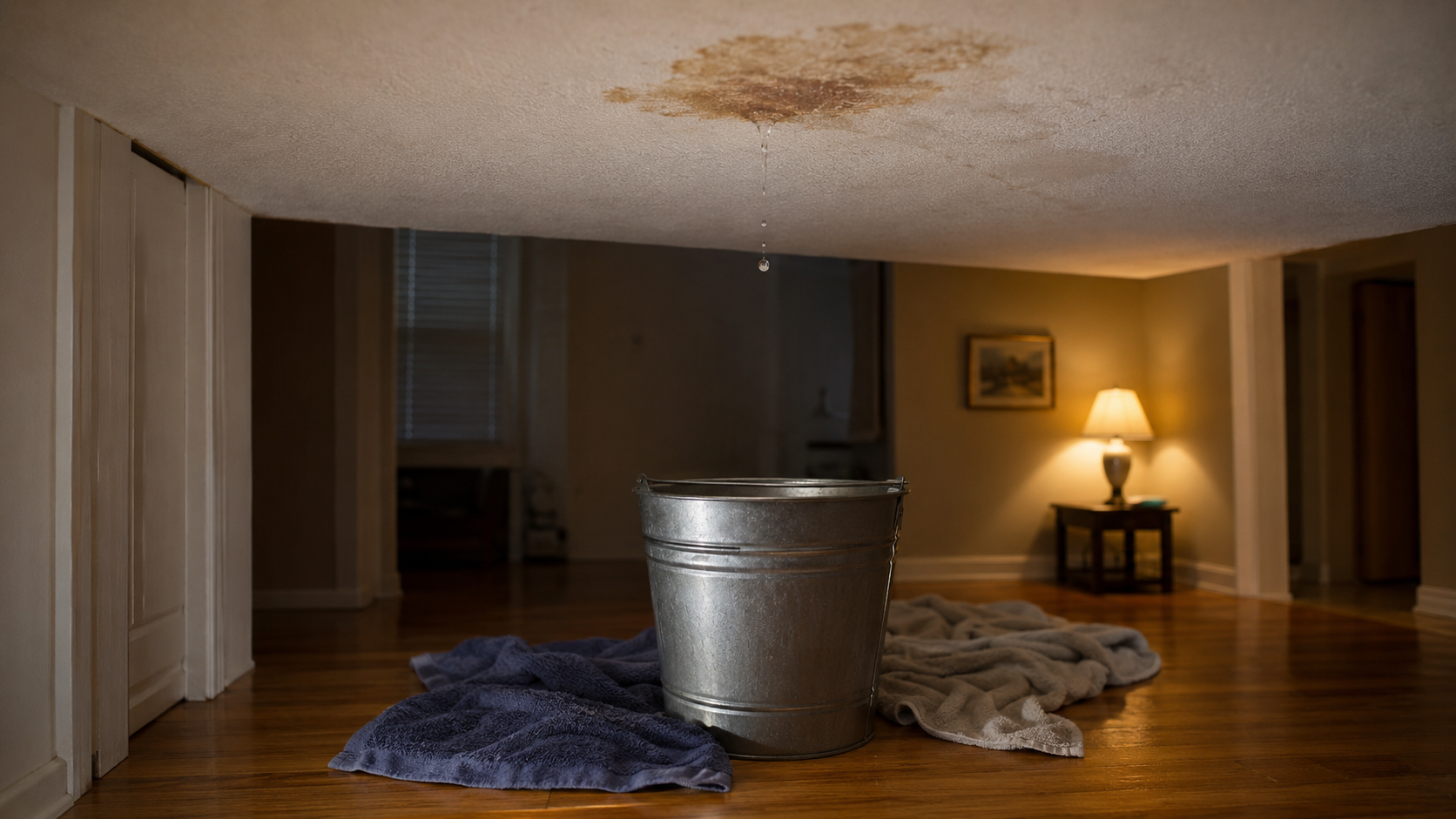
Step 3: Contain the water. Place buckets, trash cans, or any waterproof containers under every active drip point. Lay towels or plastic sheeting around the containers to catch splashes. If standing water is accumulating on the floor, soak it up immediately. Standing water causes floor damage and creates conditions for mold within 24 to 48 hours.
Step 4: Release a ceiling bubble. If your ceiling paint is bulging downward with trapped water, place a bucket underneath and carefully puncture the lowest point with a screwdriver or nail. This releases the water in a controlled way rather than letting the entire ceiling section collapse. It sounds counterintuitive, but a small controlled hole prevents a much larger, more expensive ceiling failure.
Step 5: Move valuables. Get electronics, documents, furniture, rugs, and anything water-sensitive away from the leak zone. Cover anything you cannot move with plastic sheeting or garbage bags.
Should I Get on the Roof to Fix the Leak?
No. A wet roof is one of the most dangerous surfaces you can stand on. Professional roofers account for falls as the number one cause of serious roofing injuries, according to OSHA. During rain, wind, or darkness, the risk multiplies. No temporary patch is worth a trip to the emergency room.
Additionally, attempting a DIY repair before a professional inspects the damage can hurt your insurance claim. If you seal over the entry point, the adjuster may not be able to see the original damage, which makes it harder to document the cause and get the full scope of repair covered under your policy.
Your job during an active leak is interior containment. The exterior repair comes after the rain stops and a professional can safely access the roof.
How Do I Document the Damage for Insurance?
Start documenting before you clean up. Your smartphone is the most important tool you have right now.
Photograph everything. The drip point on the ceiling, the water on the floor, the damaged belongings, the ceiling stain, the bulging drywall, any visible damage from outside (use your phone’s zoom from the ground). Take more photos than you think you need. Insurance adjusters review these images to validate the claim.
Keep a written log. Note the date and time you discovered the leak, weather conditions, every step you took to contain the water, and every call you made. Example: “June 15, 11:30 PM. Noticed water dripping from living room ceiling. Placed bucket under drip. Moved sofa and electronics. 11:45 PM, called Family First Exteriors emergency line.”
Save receipts. If you buy tarps, buckets, towels, or a wet vacuum, keep the receipts. Emergency mitigation costs are typically reimbursable under your homeowners insurance policy. Your policy requires you to mitigate damage (stop it from getting worse), and the costs of doing so are covered.
Most Missouri homeowners policies require you to report damage within 48 hours to 30 days depending on the carrier. Call your insurance company as soon as the immediate emergency is contained.
When Should I Call an Emergency Roofer in St. Louis?
Call immediately if any of the following apply:
Water is pouring, not dripping. Your ceiling is sagging or bulging in multiple areas. A tree or large debris has hit the roof. You can see exposed decking or sky from the attic. Multiple rooms are affected simultaneously. Water is near electrical systems and you cannot safely isolate the circuits.
A professional emergency roofer will tarp the damaged area to prevent further water entry, inspect the roof once conditions are safe, document the damage for your insurance claim, and provide a repair or replacement scope. Family First Exteriors provides 24/7 emergency response for storm damage across the St. Louis metro area.
Be cautious of who you call. After major St. Louis storms, door-to-door contractors appear within hours offering “emergency” repairs. Use a local contractor with a permanent address and a track record in the St. Louis area. Family First Exteriors operates from 15009 Manchester Rd, Ste 261, Ballwin, MO 63011 and has been serving St. Louis homeowners since 2002.
Why Does a Roof Leak in One Spot but Enter in Another?
The wet spot on your ceiling is almost never directly below the hole in the roof. Water enters at one point, then travels along rafters, roof deck panels, pipes, and even electrical wiring before finding a low point where it finally drips through. The actual entry point can be 10 to 20 feet from the visible drip.
This is why DIY patching from inside the attic rarely works. You might seal the drip point, but the entry point on the roof surface remains open. A professional roofer traces the moisture path back to the true entry point using experience and, in some cases, infrared thermal cameras.
If you can safely access your attic during dry conditions (not during an active storm), look for water-stained wood, matted insulation, and “shiners” (nails that look frosted or white from moisture). These clues help narrow down the entry location.
About Family First Exteriors
Family First Exteriors, LLC provides 24/7 emergency roof leak and storm damage response across the greater St. Louis area. The company also provides roofing replacement and repair, siding, soffit, and fascia, gutter systems, and replacement windows. In business since 2002. A 20% discount is available to veterans, first responders, and senior citizens. Financing available.
15009 Manchester Rd, Ste 261,
Ballwin,
MO
63011
Phone: (314) 255-8151
Request Emergency Service
Frequently Asked Questions
What should I do first when my roof is leaking?
Protect people first, then kill electricity to any room where water is near light fixtures or outlets. Place buckets under drips, lay towels to catch splashes, and move electronics and furniture away from the water. If the ceiling is bulging, puncture the lowest point to release trapped water into a bucket. Do not get on the roof.
Should I get on my roof during a leak to fix it?
No. A wet roof is extremely dangerous. Falls are the number one cause of serious roofing injuries according to OSHA. Attempting a DIY repair during rain or darkness puts you at risk and can also hurt your insurance claim by concealing the original damage before a professional can document it. Stay inside and focus on interior containment.
How fast does water damage cause mold?
Mold can begin growing within 24 to 48 hours of water exposure in drywall, insulation, and wood framing. This is why containing a leak immediately is critical. Soak up standing water, run fans to improve air circulation, and do not let wet materials sit without drying. The faster you act, the less likely mold becomes a secondary problem.
How much does emergency roof tarping cost in St. Louis?
Professional emergency roof tarping in the St. Louis area costs $300 to $800 depending on roof accessibility and the size of the damaged area. A DIY tarp job costs $50 to $150 in materials. Professional tarping is usually reimbursable through your homeowners insurance under the mitigation/temporary repair provision of your policy.
Does insurance cover emergency roof leak repairs?
Most Missouri homeowners insurance policies cover storm-related roof damage and the emergency mitigation steps you take to prevent further damage (tarping, water extraction, temporary repairs). Your policy requires you to mitigate, and the costs of doing so are typically reimbursable. Save all receipts and report the damage to your insurer within 48 hours to 30 days depending on your policy.
Why is the leak on my ceiling not directly below the hole in my roof?
Water enters the roof at one point but travels along rafters, roof deck panels, pipes, and wiring before finding a low point where it drips through the ceiling. The actual entry point can be 10 to 20 feet from the visible drip. This is why DIY patching from the attic rarely solves the problem. A professional traces the moisture path to the true entry point.
Roof Leaking Right Now? Call Us.
Family First Exteriors provides 24/7 emergency roof leak response throughout the St. Louis metro area.
Serving Ballwin, Kirkwood, Webster Groves, Creve Coeur, Chesterfield, Wildwood, Des Peres, Ellisville, Maplewood, and the entire St. Louis metro.