
June 12, 2026
Cool Roofs and Energy-Efficient Shingles: Can They Lower Your Bills in St. Louis?
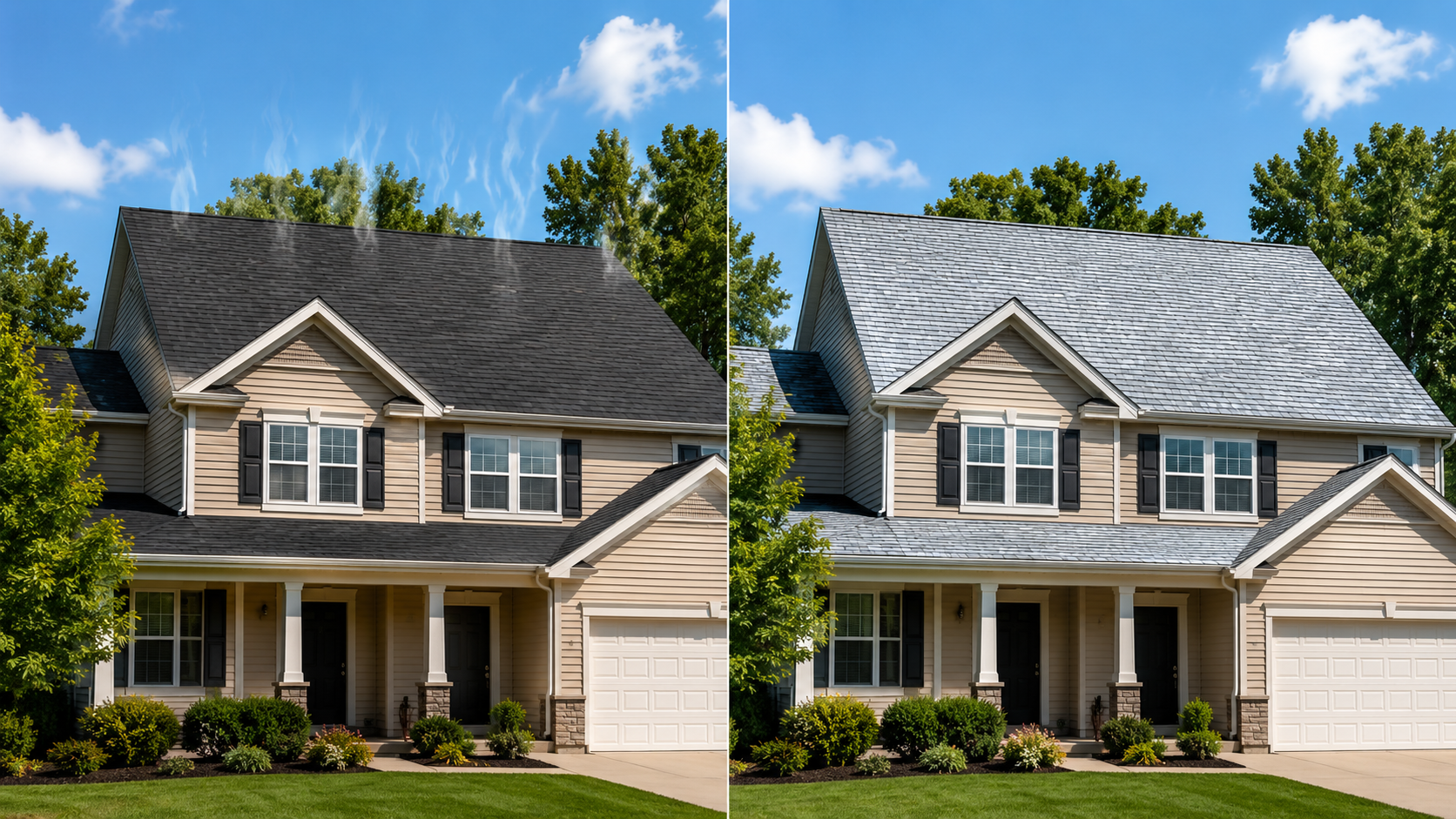
Cool roof shingles with infrared-reflective granules can reduce your roof’s surface temperature by 20 to 30 degrees Fahrenheit compared to traditional dark shingles, according to the Cool Roof Rating Council. In the St. Louis climate, where summer temperatures regularly exceed 95 degrees and Ameren Missouri rates have risen 34.5% since 2020, that translates to a realistic 5% to 12% reduction in summer cooling costs. For a household spending $150 to $250 per month on air conditioning from May through September, that is $40 to $150 in annual savings. The upgrade adds roughly $300 to $800 to a standard roof replacement. Here is what actually works, what does not, and what matters more than shingle choice.
What Is a Cool Roof and How Does It Work?
A cool roof is any roofing system designed to reflect more sunlight and absorb less heat than a standard roof. The performance is measured by two properties: solar reflectance (how much sunlight the surface bounces back) and thermal emittance (how efficiently the surface releases absorbed heat). Higher numbers on both metrics mean a cooler roof surface, a cooler attic, and less work for your air conditioner.
Traditional dark asphalt shingles absorb up to 90% of solar energy. On a 95-degree St. Louis summer day, a conventional dark roof surface can reach 150 degrees Fahrenheit or higher. That heat radiates into the attic, which can hit 140 to 160 degrees, and then seeps into your living space through the ceiling. Your HVAC system works overtime to compensate.
Cool roof shingles use specially engineered granules embedded with infrared-reflective pigments. These pigments reflect the invisible infrared portion of sunlight (which carries most of the heat energy) while still allowing the shingle to appear dark in color. This is the key innovation: you do not have to choose a white or light-colored roof to get the cooling benefit. Modern cool shingles come in grays, browns, and other standard colors.
How Much Can Cool Roof Shingles Actually Save in St. Louis?
This is where marketing claims and reality diverge. You will find articles claiming 25% to 40% energy savings from cool roofs. Those numbers come from studies done in cooling-dominated climates like Phoenix or Miami, where air conditioning runs 8 to 10 months per year. St. Louis is a four-season climate where heating costs (November through March) are often higher than cooling costs. A product that only helps during the cooling season works for roughly 40% of the year here.
Realistic savings for a St. Louis home with cool roof shingles:
| Metric | Realistic Range | Source |
|---|---|---|
| Roof surface temperature reduction | 20 to 30°F lower | Cool Roof Rating Council |
| Attic temperature reduction | 10 to 20°F lower | DOE / industry field studies |
| Summer cooling cost reduction | 5% to 12% | DOE (10-15%), adjusted for 4-season Midwest climate |
| Annual dollar savings | $40 to $150 | Based on St. Louis summer AC spend of $750-$1,250 |
| Cumulative savings (25-year roof life) | $1,000 to $3,750 | Calculated from annual range |
| Cool shingle upgrade cost | $300 to $800 | County Roofing Systems (2026) |
| Payback period | 3 to 8 years | Calculated from cost vs. savings |
The payback math works in St. Louis, but the savings are modest, not transformative. If someone tells you cool shingles will “slash your energy bill by 30%,” they are quoting Arizona data, not Missouri data.
What Matters More Than Shingle Choice for Energy Efficiency?
This is the section most roofing websites skip because it does not sell shingles. But it is the most important part of the conversation for St. Louis homeowners who actually want lower energy bills.
If you ranked the three things that affect your roof’s energy performance, the order is: insulation first, ventilation second, shingle choice third. It is not close.
Attic insulation. The Missouri Energy Code requires a minimum of R-38 attic insulation in the St. Louis area. Many homes built before 1990 have R-19 or less. Upgrading from R-19 to R-38 reduces heat transfer through the ceiling by roughly 50%, which dwarfs anything a cool shingle can do. If your attic insulation is below R-38, address that before spending money on reflective shingles. The insulation upgrade will deliver 3 to 5 times more savings than the shingle upgrade alone.
Attic ventilation. Proper soffit-to-ridge ventilation (1 square foot of net free vent area per 150 to 300 square feet of attic floor, per IRC R806.2) allows hot air to escape the attic naturally. A poorly ventilated attic traps heat regardless of what shingle is on top. When Family First Exteriors replaces a roof, we evaluate ventilation as part of the project and recommend upgrades if the current system does not meet code. Ventilation improvements are part of the roofing project scope, not a separate expense.
Then shingle choice. Once insulation and ventilation are right, cool shingles add an incremental benefit on top of a system that is already performing well. Think of it as the final 5% to 12%, not the primary solution.
Which Cool Roof Shingles Are Available in St. Louis?
All three major manufacturers offer ENERGY STAR rated cool shingle products that are available through St. Louis distributors:
GAF Timberline Cool Series (CS). Uses infrared-reflective granules across GAF’s popular Timberline platform. Available in multiple colors. Compatible with GAF’s warranty system, including enhanced warranties through certified contractors.
Owens Corning Cool Color Collection. Reflective granule technology applied to Owens Corning’s Duration and TruDefinition lines. ENERGY STAR rated. Available in colors designed for typical residential aesthetics.
IKO Dynasty Cool Colors Plus. Features embedded infrared-reflective pigments with a Solar Reflectance Index (SRI) of 20 or greater. Increases roof reflectivity by 25% above California Title 24 requirements. Available in a variety of standard residential colors.
All three product lines look like standard architectural shingles. The reflective technology is embedded in the granule coating, not visible to the eye. Your neighbors will not know you have a cool roof unless you tell them.
Cost premium over standard shingles of the same product line: $300 to $800 for a typical St. Louis home, depending on roof size and product selection.
Why Energy-Efficient Roofing Matters More Than Usual in St. Louis Right Now
Ameren Missouri electricity rates are climbing. Between 2020 and 2025, the average summer bill for an Ameren residential customer rose 34.5%, according to a report from the Consumers Council of Missouri published in The Beacon. A 12% rate hike took effect in June 2025, and the Consumers Council projects that recent Missouri legislation (Senate Bill 4) could add up to $1,115 annually to household utility bills as it is fully utilized.
Some Ameren customers saw summer bills spike from $105 to $254 in a single month during the 2025 heat wave, according to Fox 2 St. Louis. When electricity costs $0.14 per kilowatt-hour (Missouri’s current average) and rising, every degree of cooling your roof can provide translates into real dollars.
A roof replacement is the natural time to upgrade to cool shingles because the labor cost is already being paid. Adding $300 to $800 for reflective granule shingles during a $12,000 re-roof is a modest premium for a benefit that accumulates every summer for 25 to 30 years.
Are There Tax Credits for Energy-Efficient Roofing in 2026?
Certain ENERGY STAR rated roofing products may qualify for the federal energy efficiency tax credit under Section 25C of the Internal Revenue Code. The specifics on which products qualify and the credit amounts have been revised multiple times in recent years. Check energystar.gov for current eligibility or consult your tax advisor before counting on a credit.
Missouri does not currently offer a separate state-level tax credit for cool roofing, but Ameren Missouri does offer energy efficiency rebate programs for certain home upgrades. Check Ameren’s residential energy efficiency page for current program availability.
About Family First Exteriors
Family First Exteriors, LLC installs standard and energy-efficient roofing systems throughout the greater St. Louis area. The company also handles storm damage and insurance claims, siding, soffit, and fascia, gutter systems, and replacement windows. In business since 2002. A 20% discount is available to veterans, first responders, and senior citizens. Financing available.
15009 Manchester Rd, Ste 261,
Ballwin,
MO
63011
Phone: (314) 255-8151
Request a Free Estimate
Frequently Asked Questions
How much can cool roof shingles save on energy bills in St. Louis?
In the St. Louis four-season climate, cool roof shingles realistically reduce summer cooling costs by 5% to 12%, which translates to $40 to $150 per year for a typical household. Over a 25-year roof lifespan, cumulative savings range from $1,000 to $3,750. The upgrade costs $300 to $800 during a standard roof replacement, with a payback period of 3 to 8 years.
Do cool roof shingles have to be white or light colored?
No. Modern cool roof shingles use infrared-reflective pigments embedded in the granule coating. These pigments reflect heat-carrying infrared light while allowing the shingle to appear in standard dark colors like charcoal, brown, and gray. They look identical to regular architectural shingles.
What matters more for energy efficiency: shingles, insulation, or ventilation?
Insulation first, ventilation second, shingle choice third. Upgrading attic insulation from R-19 to R-38 reduces heat transfer by roughly 50%, far more than any shingle change. Proper soffit-to-ridge ventilation allows trapped heat to escape. Cool shingles add an incremental 5% to 12% on top of a well-insulated, well-ventilated system.
Which cool roof shingles are available in St. Louis?
GAF Timberline Cool Series, Owens Corning Cool Color Collection, and IKO Dynasty Cool Colors Plus are all available through St. Louis distributors. All three are ENERGY STAR rated, use infrared-reflective granule technology, and come in standard residential colors. The cost premium over standard shingles is $300 to $800 for a typical home.
Is there a tax credit for cool roof shingles in 2026?
Certain ENERGY STAR rated roofing products may qualify for the federal energy efficiency tax credit under Section 25C. The specifics have been revised multiple times. Check energystar.gov for current eligibility or consult your tax advisor. Missouri does not currently offer a separate state tax credit for cool roofing, but Ameren Missouri has energy efficiency rebate programs worth checking.
Are Ameren Missouri electricity rates going up?
Yes. Average summer bills for Ameren residential customers rose 34.5% between 2020 and 2025, according to the Consumers Council of Missouri. A 12% rate hike took effect in June 2025. The Consumers Council projects recent Missouri legislation could add up to $1,115 annually to household bills. Rising rates make energy-efficient roofing upgrades more valuable each year.
Replacing Your Roof? Ask About Energy-Efficient Shingle Options.
Family First Exteriors can quote standard and cool roof shingles side by side. We also evaluate insulation and ventilation as part of every roof replacement.
(314) 255-8151 | Request Your Free Estimate Online
Serving Ballwin, Kirkwood, Webster Groves, Creve Coeur, Chesterfield, Wildwood, Des Peres, Ellisville, Maplewood, and the entire St. Louis metro. 20% discount for veterans, first responders, and seniors.