
June 9, 2026
Your Roof Is 20 Years Old: Now What? A Decision Guide for St. Louis Homeowners
A 20-year-old asphalt shingle roof in St. Louis is not automatically done, but it is in the decision zone. Standard 3-tab shingles installed in the early 2000s were rated for 15 to 20 years. Architectural shingles from that era were rated for 25 to 30 years, but St. Louis weather (42 inches of annual rain, 30 to 40 freeze-thaw cycles per winter, regular hail from April through June) shortens those numbers in practice. At 20 years, you are either replacing soon or spending strategically on repairs to extend the remaining life. This guide walks you through the decision with actual numbers.
Is a 20-Year-Old Roof Too Old?
It depends on the material, installation quality, maintenance history, and how much St. Louis weather it has absorbed. Here is a realistic lifespan range for each material type, based on data from the National Association of Home Builders (NAHB) and the U.S. Department of Housing and Urban Development (HUD):
| Material | Rated Lifespan | Realistic St. Louis Lifespan | Status at 20 Years |
|---|---|---|---|
| 3-Tab Asphalt Shingles | 15 to 20 years | 12 to 18 years | At or past end of life |
| Architectural Asphalt Shingles | 25 to 30 years | 20 to 25 years | Entering final third |
| Standing Seam Metal | 40 to 60 years | 35 to 50 years | Mid-life, likely fine |
| Flat Roof (TPO/EPDM) | 15 to 25 years | 12 to 20 years | At or near end of life |
If your St. Louis home has 3-tab shingles installed around 2004 to 2006, those shingles are at or past their expected service life. If you have architectural shingles from the same period, you likely have 3 to 7 years of remaining life, assuming no major storm damage has occurred. A professional inspection is the only way to know where your specific roof falls within these ranges.
What Are the Warning Signs on a 20-Year-Old Roof?
At the 20-year mark, damage is often subtle from the ground. Here is what to look for and what each sign means:
Granule loss in gutters. Check the bottom of your downspouts and gutter channels after a rain. A thin layer of granules is normal shedding. Heavy accumulation that looks like coarse black sand means the shingles are losing their protective coating. Once exposed, the underlying asphalt degrades rapidly under St. Louis summer UV.
Curling or cupping shingles. Look at the roof from across the street. Shingles that curl upward at the edges or cup in the center have lost flexibility from moisture cycling and UV exposure. Curled shingles are vulnerable to wind uplift and water infiltration. If curling is widespread (more than a few scattered shingles), the roof is signaling systemic age failure, not isolated damage.
Cracked shingles. Brittleness is a hallmark of aged asphalt. Shingles that crack from thermal movement or minor hail impact (stones under 1 inch) have lost the flexibility they had when new. A 10-year-old shingle absorbs a 1-inch hailstone. A 20-year-old shingle cracks from the same impact.
Missing shingles. If shingles are blowing off in moderate wind events (under 60 mph), the adhesive strip has failed. On a 20-year-old roof, this is age-related, not a defect.
Daylight in the attic. On a sunny day, go into the attic with the lights off. If you see pinpoints of light through the roof deck, water is getting through too.
Rising energy bills. A deteriorating roof loses insulation effectiveness. If your heating and cooling costs have crept up over the past 2 to 3 years without an obvious explanation (rate increases, HVAC issues), the roof may be part of the problem.
Should I Repair or Replace a 20-Year-Old Roof?
This is the core question, and the answer is arithmetic, not guesswork. Here is the framework roofing professionals use:
Repair makes financial sense when: the damage covers less than 25% of the roof area, the repair cost is under 30% of what a full replacement would cost, the remaining roof is in sound condition with 5 or more years of expected life, and matching shingles are still manufactured and available.
Replacement is the better investment when: damage or wear is widespread across multiple slopes, you are spending $500 or more per year on recurring repairs, your insurance has switched your roof coverage from replacement cost value (RCV) to actual cash value (ACV) because of the roof’s age, granule loss is heavy and systemic, or the roof has already been patched multiple times.
A useful rule of thumb cited by Home Guide: if repairs exceed 30% of what a new roof would cost, replacement almost always makes more financial sense. On a $12,000 replacement, that threshold is $3,600. If you are facing a $4,000 repair bill on a 20-year-old roof, that money is better spent as a down payment on a new roof that comes with a 25 to 30 year warranty.
Why the Math Changes After 15 to 20 Years in Missouri
Three factors specific to Missouri make the repair-vs-replace calculation different at the 20-year mark than it was when your roof was younger:
Insurance coverage shifts from RCV to ACV. Several Missouri insurance carriers automatically convert roof coverage from replacement cost value to actual cash value once the roof reaches 15 to 20 years of age. Under ACV, your payout is based on the depreciated value of the roof, not the cost to replace it. A 20-year-old roof on a 25-year shingle has lost roughly 80% of its value through depreciation. If a storm damages that roof, your ACV payout may barely cover the deductible, let alone the replacement. Replacing proactively resets the clock and restores full RCV coverage on a new roof.
Percentage-based deductibles increase your risk. Missouri insurers have shifted wind and hail deductibles from flat-dollar amounts to 1% to 3% of your home’s insured value. On a $300,000 home, that is $3,000 to $9,000 out of pocket per claim. With an aging roof that is more likely to sustain hail damage, you face higher claim frequency and higher per-claim costs. Replacing with new shingles (especially Class 4 impact-resistant shingles) reduces both.
Material costs are rising, not falling. GAF, Owens Corning, and CertainTeed have all announced 6% to 10% price increases effective June 1, 2026, on top of a prior 4% to 8% round in April 2026. The NAHB reports that building material costs are 40% above December 2020 levels. Waiting 12 months to replace means paying 12 months of higher prices. Today’s price is the lowest it will be for the foreseeable future.
What If I Am Selling My Home in the Next Few Years?
If you plan to sell within 3 to 5 years, the calculation shifts. A full roof replacement returns approximately 60% to 70% of its cost at resale, according to national remodeling cost-vs-value data. That means a $12,000 replacement adds roughly $7,200 to $8,400 to your sale price, not the full $12,000.
For a near-term sale, targeted repairs often make more financial sense: fix visible damage, replace missing shingles, address any active leaks, and make the roof pass a buyer’s inspection. Spend the smaller dollars to make the roof presentable and let the next owner manage the long-term replacement.
However, if the roof is visibly failing (heavy granule loss, widespread curling, multiple patches), buyers in competitive St. Louis County markets like Creve Coeur, Chesterfield, and Kirkwood will either demand a price reduction or walk. In that scenario, replacing before listing can actually accelerate the sale and strengthen your negotiating position.
What Does a Roof Replacement Cost at the 20-Year Mark in St. Louis?
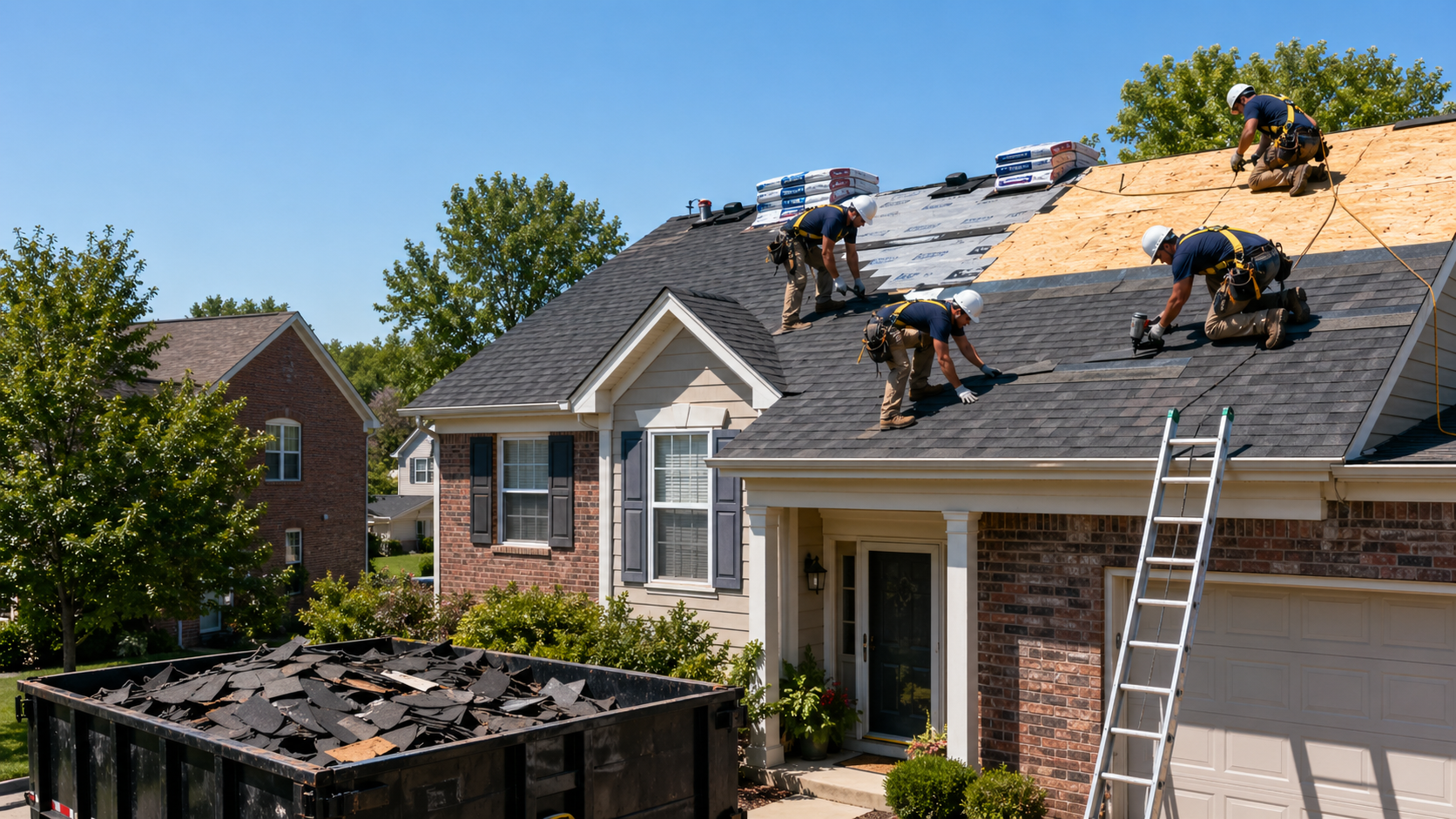
A full tear-off and re-roof with architectural asphalt shingles on a typical 2,000 square foot St. Louis home costs $8,500 to $15,000 installed in 2026, with a realistic midpoint of $12,000 to $14,000. Upgrading to Class 4 impact-resistant shingles adds $1,500 to $3,000 but can lower your Missouri insurance premium by 10% to 35% annually.
At the 20-year mark, expect one additional cost that newer roofs may not face: decking repair. After 20 years of St. Louis weather, it is common to find sections of rotted or water-damaged plywood or OSB sheathing underneath the old shingles. This runs $50 to $100 per sheet to replace. Get a per-sheet price in your contract before work starts.
Family First Exteriors offers financing options that let you spread the cost over 12 to 60 months. A 20% discount is available to veterans, first responders, and senior citizens.
The 20-Year Roof Checklist: What to Do Right Now
If your roof is 18 to 22 years old, here are five steps to take this month:
1. Schedule a professional inspection. A qualified roofing contractor can assess remaining life, document current condition with photos, and give you an honest timeline. This baseline documentation is also critical if you file a storm damage claim later.
2. Check your insurance declarations page. Confirm whether your roof is covered at RCV or ACV, and note your wind/hail deductible percentage. If you are on ACV, understand what your actual payout would be in a claim scenario.
3. Get a replacement estimate even if you are not ready. Having a number on paper lets you plan, budget, and compare financing options without pressure. Most St. Louis contractors provide free estimates.
4. Ask about your shingle manufacturer and product line. If you do not know what is on your roof, your inspector can identify it. Knowing the product tells you the rated lifespan and whether matching shingles are still available for spot repairs.
5. Do not ignore small problems. A $300 flashing repair at year 20 can prevent a $3,000 interior water damage bill at year 21. Stay on top of minor issues while you plan the larger decision.
About Family First Exteriors
Family First Exteriors, LLC provides free roof inspections, repairs, and replacements throughout the greater St. Louis area. The company also handles storm damage and insurance claims, siding, soffit, and fascia, gutter systems, and replacement windows. In business since 2002. A 20% discount is available to veterans, first responders, and senior citizens. Financing available.
15009 Manchester Rd, Ste 261,
Ballwin,
MO
63011
Phone: (314) 255-8151
Request a Free Estimate
Frequently Asked Questions
Is a 20-year-old roof too old?
Not necessarily. A 20-year-old roof with 3-tab shingles is at or past its rated lifespan (15 to 20 years) and likely needs replacement. Architectural shingles rated for 25 to 30 years may have 3 to 7 years of remaining life at the 20-year mark, depending on maintenance and weather exposure. A professional inspection is the only way to know for certain.
Should I repair or replace a 20-year-old roof?
Repair makes sense when damage covers less than 25% of the roof, the cost is under 30% of a full replacement, and the remaining roof has 5 or more years of expected life. If repairs exceed 30% of replacement cost, or if you are spending $500 or more per year on recurring fixes, replacement is the better financial decision.
Does insurance cover a 20-year-old roof in Missouri?
Storm damage is covered, but the payout may be reduced. Several Missouri carriers switch roof coverage from replacement cost value (RCV) to actual cash value (ACV) at 15 to 20 years. Under ACV, a 20-year-old roof’s depreciated value may produce a payout that barely exceeds your deductible. Check your declarations page to confirm your coverage type.
How much does it cost to replace a 20-year-old roof in St. Louis?
A full tear-off and re-roof with architectural shingles on a 2,000 square foot St. Louis home costs $8,500 to $15,000 in 2026. At the 20-year mark, budget additional for decking repair ($50 to $100 per sheet) since rotted sheathing is common after two decades of St. Louis weather. Upgrading to Class 4 impact-resistant shingles adds $1,500 to $3,000.
Should I replace my roof before selling my house?
If you are selling within 3 to 5 years, targeted repairs usually offer better ROI than full replacement. A new roof returns roughly 60% to 70% of its cost at resale. However, if the roof is visibly failing (heavy granule loss, widespread curling, multiple patches), buyers in competitive St. Louis markets will demand a price reduction or walk away.
What is the first thing I should do if my roof is 20 years old?
Schedule a professional roof inspection. A qualified contractor will assess remaining life, document the current condition with photos, and give you an honest timeline for repair or replacement. This documentation also serves as a baseline if you file a storm damage insurance claim later. Most St. Louis contractors offer free inspections.
Is Your Roof Approaching 20 Years?
Family First Exteriors provides free roof inspections with photo documentation. We will tell you honestly how much life is left and what your options are.
(314) 255-8151 | Request Your Free Inspection Online
Serving Ballwin, Kirkwood, Webster Groves, Creve Coeur, Chesterfield, Wildwood, Des Peres, Ellisville, Maplewood, and the entire St. Louis metro. 20% discount for veterans, first responders, and seniors.